Amazon just upped the ante in space infrastructure, with its eye-catching satellite company purchase. In close coordination with Apple, who also has a long-term eye on this tech stack layer.
The details are worth unpacking in these early days of this AI Tech Wave . In particular, because direct satellite to phone broadband at some point promises to be the holy grail of global satellite based, internet connectivity. Beyond the current core business of these networks providing satellite broadband to rural homes and flying airplanes.
But the subject at hand here is Amszon with its Leo satellite company, revving up to be a prime competitor to Elon’s Starlink/SpaceX/xAI/Tesla conglomeration.
“Deal adds 2 dozen satellites to Amazon network, but rivaling Starlink still a challenge”
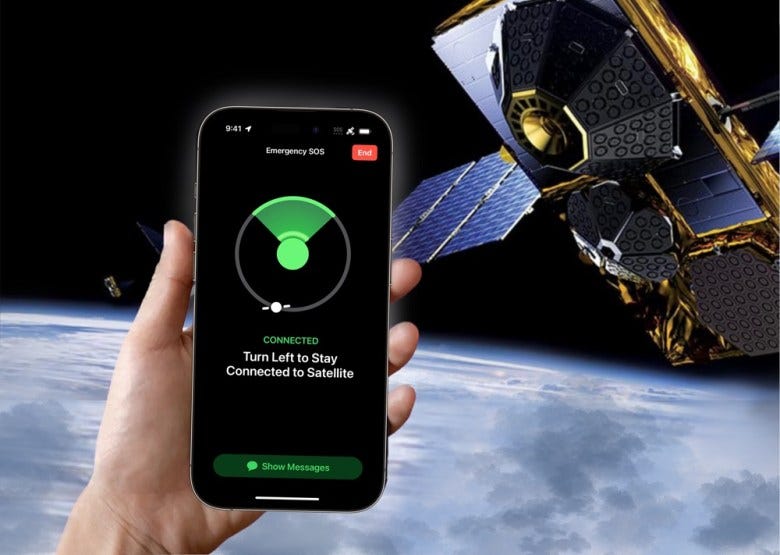
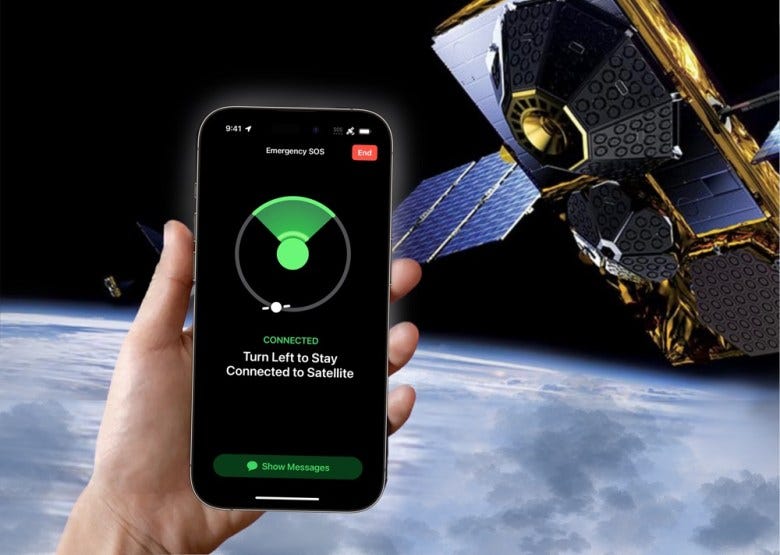
“Globalstar network will continue serving Apple features like Emergency SOS”
“Satellite firm’s shares rise 10%, Amazon up 3%”
“Amazon aid on Tuesday it will acquire Globalstar (GSAT.O), opens new tab in an $11.57 billion deal, bolstering its fledgling satellite business as it tries to catch up with Elon Musk’s Starlink.”
Space of course is a whole VC investment category unto itself of late, turbo-charged of late by Elon Musk:
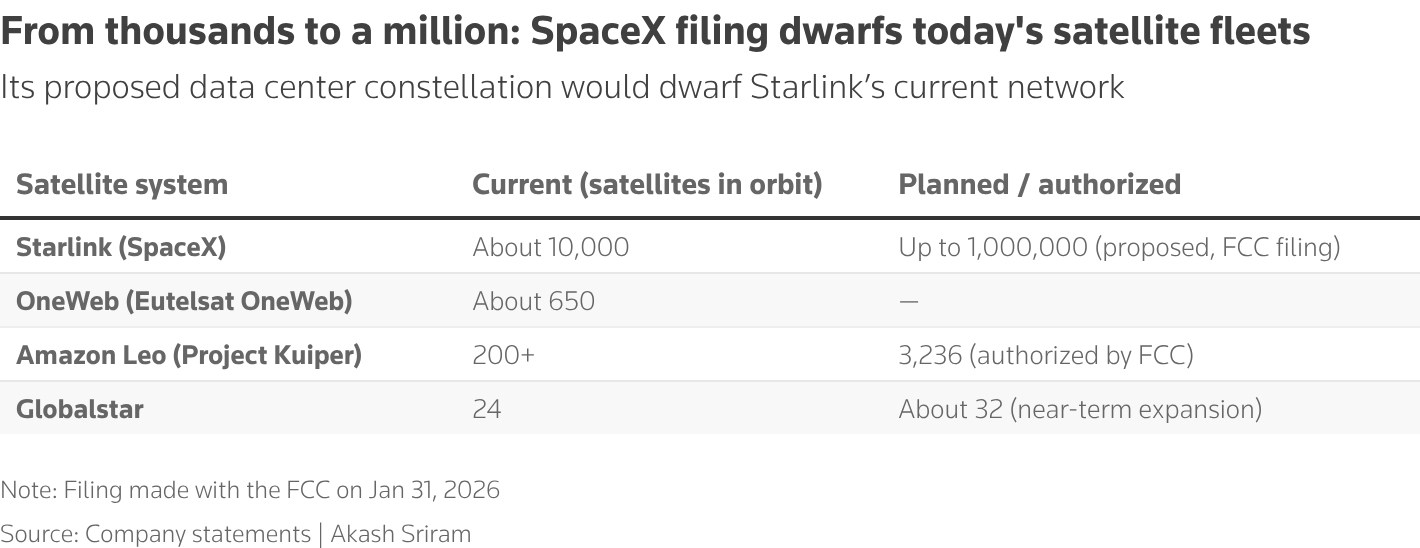
“Tech companies are pouring billions of dollars into capturing the lucrative market for satellite-based connectivity, but it will be a tall order to match Starlink’s 10,000-unit-strong network. Through the deal, Amazon adds Globalstar’s two dozen satellites to its existing network of more than 200.”
“Amazon has been working to ramp up its network by deploying about 3,200 satellites in Earth’s low orbit by 2029, with roughly half required to be in place by a July regulatory deadline. It is also preparing to roll out its satellite internet services later this year.”
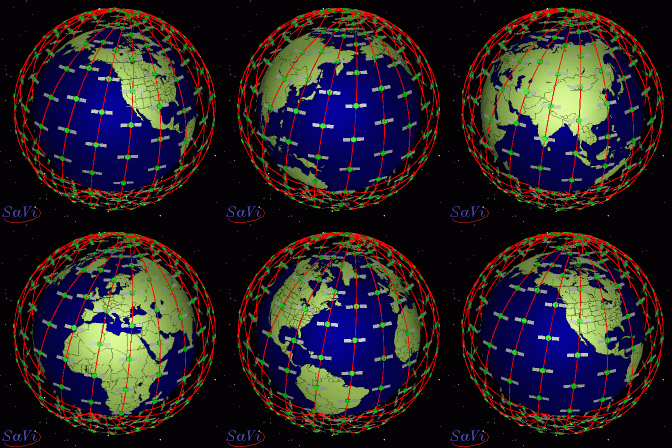
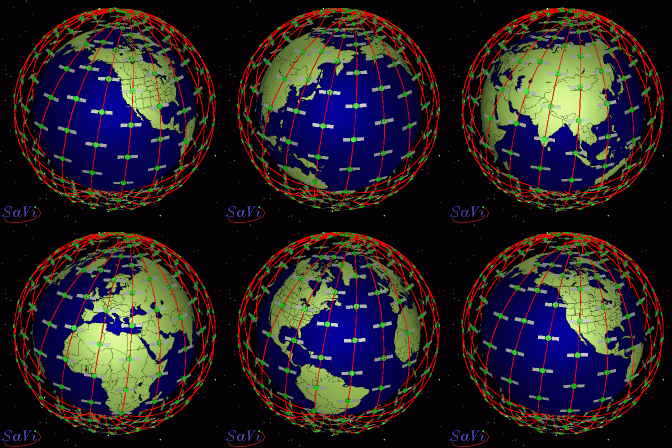
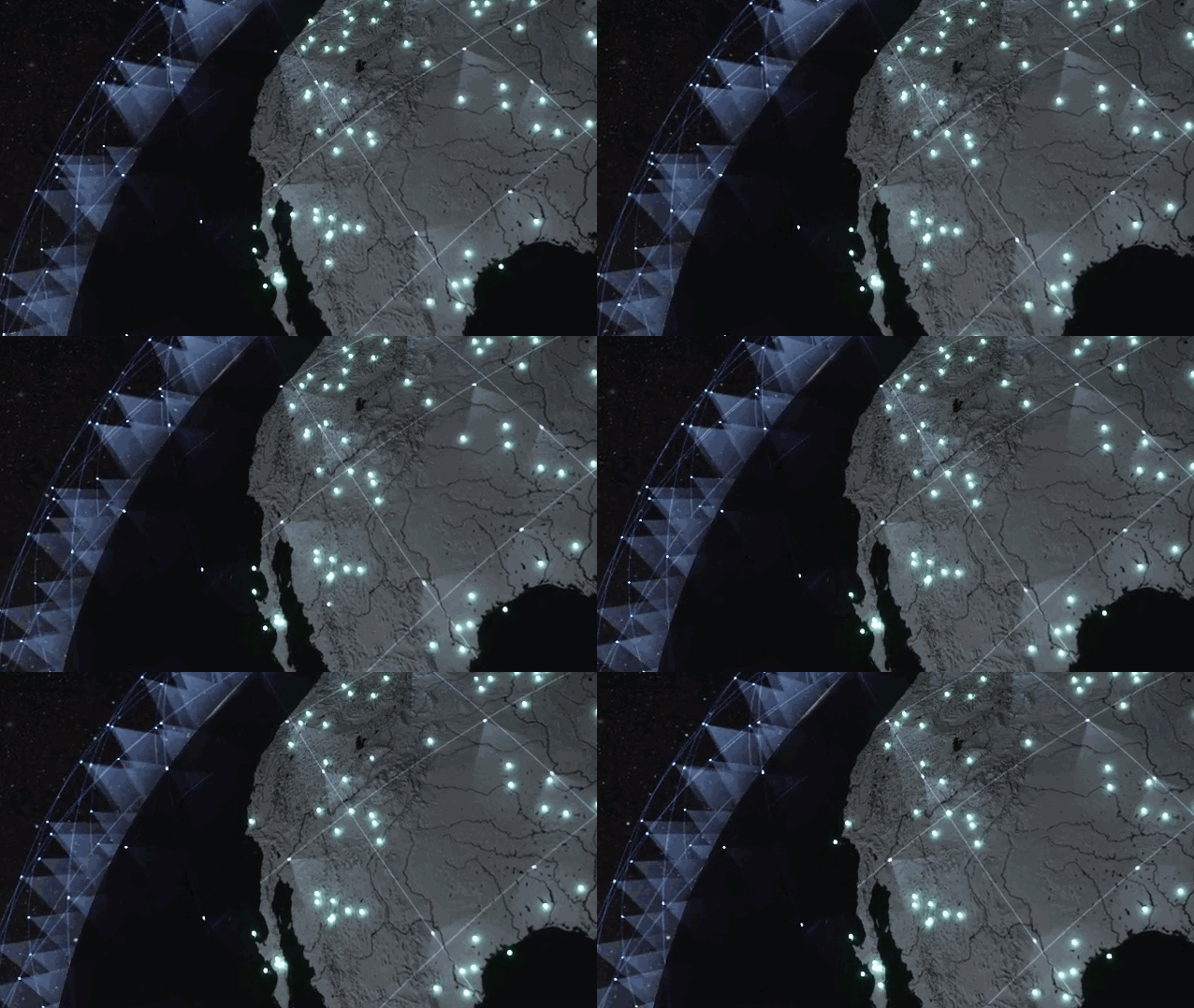
So Amazon Leo is a distant second to Starlink with its 10,000+ satellites. That number representing over half of the satellites circling around the Earth.
Globalstar in these context of these nw ‘low-earth orbit’ satellite networks, is considered a relatively legacy provider.
“Globalstar’s satellite network is designed for reliable, low-data connections directly to mobile devices, or Direct-to-Device (D2D). The technology removes the need for devices to connect to ground-based cellular towers, making them crucial in powering emergency services and delivering connectivity in areas with limited cellular coverage.”
“The deal will help Amazon deploy D2D from 2028, the companies said.”
Again, Starlink dominates the industry in units and customers served.
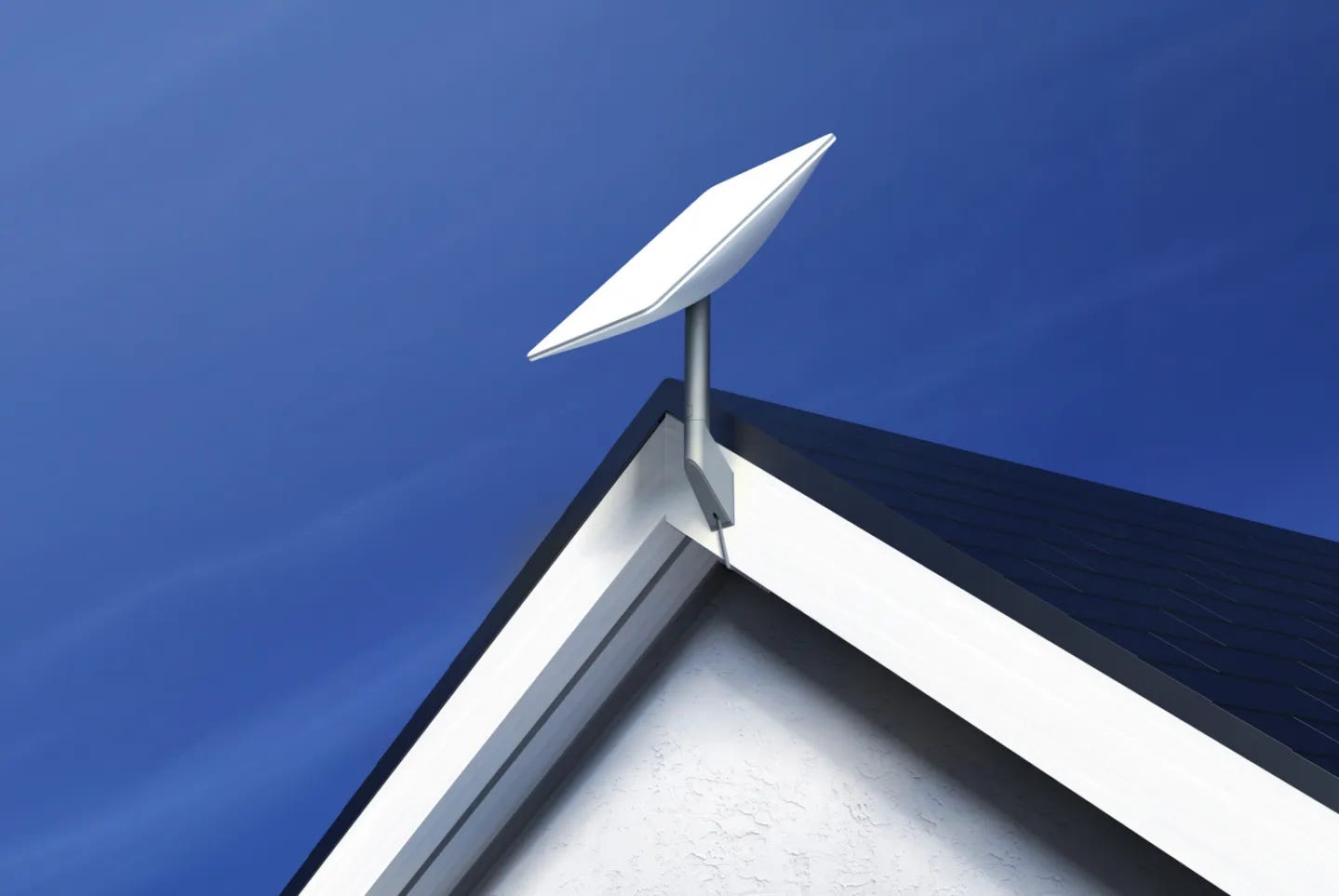
“Meanwhile, Starlink already serves more than 9 million users globally. The SpaceX unit, which provides high-speed broadband through user terminals, is also developing D2D services through partnerships with telecom operators such as T-Mobile.”
“Amazon has been falling behind Starlink on satellite broadband. Acquiring Globalstar allows them to catch up on their D2D spectrum position, and leap ahead on D2D deployment,” said Armand Musey, president & founder of Summit Ridge Group.”
The Globalstar network provides relatively prosaic services smartphones, for Apple and others.
“Globalstar currently powers satellite-based safety features such as Emergency SOS and Find My for Apple’s (AAPL.O), opens new tab iPhone and Apple Watch users. Amazon said that it has signed an agreement with Apple to continue providing those services.”
“Apple invested about $1.5 billion in Globalstar in 2024 to fund the expansion of its iPhone communication services, in a deal that also gave the tech giant a 20% equity in Globalstar.”
“Globalstar said late last year that a new, Apple-backed network under development would expand its footprint to 54 satellites, including a small number of backups, from the two dozen currently.”
Of course, Starlink’s parent SpaceX/xAI overshadows it all as discussed above.
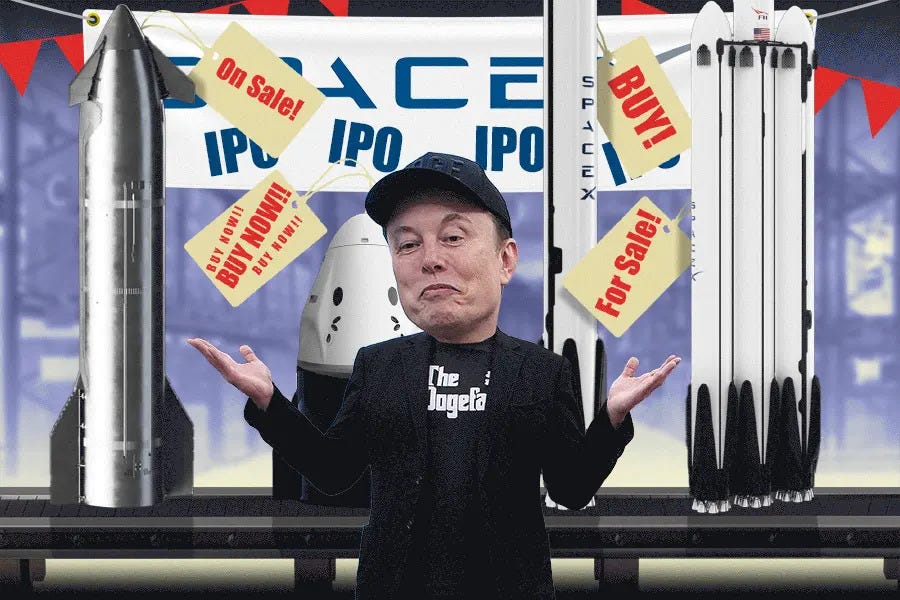
“Amazon’s move comes closely on the heels of SpaceX moving forward with its IPO plan.”
“Musk’s SpaceX has been deploying Starlink satellites at a rapid pace, launching dozens at a time and building the world’s largest satellite constellation. Starlink represents roughly 50% to 80% of SpaceX’s revenue.”
“Starlink generated $11.4 billion revenue, 61% of SpaceX’s total sales.”
“Starlink’s 63% adjusted Ebitda margin made it SpaceX’s only cash generator.”
“Rocket and AI units burned cash, making Starlink crucial for SpaceX IPO.”
“A new set of numbers for Elon Musk’s SpaceX makes it clear that the success of its potential initial public offering will depend on investors embracing the growth of the company’s Starlink satellite internet business.”
“The other two businesses inside SpaceX—rocket launches and AI—are burning cash and not generating the kind of growth that makes investors willing to pay the staggering valuation Musk is seeking, according to previously unreported financial figures viewed by The Information.”
“Globalstar’s assets are, all things considered, pretty middling:
24 satellites nearing the end of their 15-year lifespan with a bent-pipe architecture (i.e. signal relaying only, no onboard processing), and 24 ground gateway stations across six continents; there are some new satellites on the way to keep the constellation going, but it seems likely that still-on-the-drawing-board higher-capability satellites will be scrapped.”
“Approximately 8 MHz of L-band satellite uplink, and approximately 16.5 MHz of S-band satellite downlink”
“n53 terrestrial spectrum (i.e. for private cellular networks, not phone-to-satellite communication) that is licensed out”
But useful nevetheless in the hurry by Amazon and others to play catch-up. Thus the details of the transaction close matter, as Reuters continues:
“The acquisition is expected to close next year, subject to regulatory approvals and achievement of specific deployment milestones by Globalstar.”
“The deal will also require approval from the U.S. Federal Communications Commission, the agency’s chair Brendan Carr said in an interview on CNBC, adding the FCC was “very open-minded” to the acquisition.”
The whole piece is worth a read for additional detail. But the key takeaway is that Space is an important extension for substantial AI infrastructure needed in this AI Tech Wave. A
nd in the context of this deal, the second largest acquisition in Amazon’s history after its $13+ billion Whole Foods deal a few years ago,Amazon is really positioning itself with Apple long-term around Space Satellite infrastructure. As Stratechery notes on this deal:
“Apple isn’t talking about exciting new features, but rather maintaining what they have — which is exactly what Amazon is promising. This, by extension, leads me to my conclusion that this deal is about Apple versus Starlink, not Amazon.”
“Specifically, I don’t think that Apple wants to partner with Starlink, for the reasons I noted above. At the same time, the Globalstar partnership was failing, which meant that Apple was stuck. I wouldn’t be surprised if they made a deal with Amazon: acquire Globalstar, keep it running for now, and in the long run add Globalstar’s capabilities to the satellites that Amazon is going to launch anyways. In return, Amazon can have a nice side business selling that capability to mobile network operators around the world, and Apple will continue to — using Greg Joswiak’s words — to build on its “long and proven track record of working together through Amazon’s core infrastructure services.” Apple already spends an estimated $1–$1.5 billion/year on AWS, which means there is plenty of latitude to make this acquisition well worth Amazon’s while, and ensure that the iPhone maker isn’t answering to Elon Musk.”
“This is, to be clear, speculation. It is, however, speculation that explains this deal much more satisfactorily than the default explanation of Amazon getting into the direct-to-device satellite business with a worse offering that doesn’t directly benefit their core reasons for launching satellites in the first place.”
Endeavors that are likely to require addtional tens of billions over the rest of this decade and beyond for the companies involved.
These moves for now look like early pieces being moved on the chessboard. Stay tuned.
(NOTE: The discussions here are for information purposes only, and not meant as investment advice at any time. Thanks for joining us here)
Good morning… If you read me/follow me you know my passion for comedy and laughs. Last year Social Leverage led the seed round in PunchUp. Danny, the...
I’ve written in detail about how market entertainer Elon Musk has been cannily adding the narrative evolution of ‘AI Space Data Centers’ to bolster his...
Just a little friendly competition, is likely the best way to describe the competitive dance between OpenAI and Microsoft. Almost a year ago, in a piece...