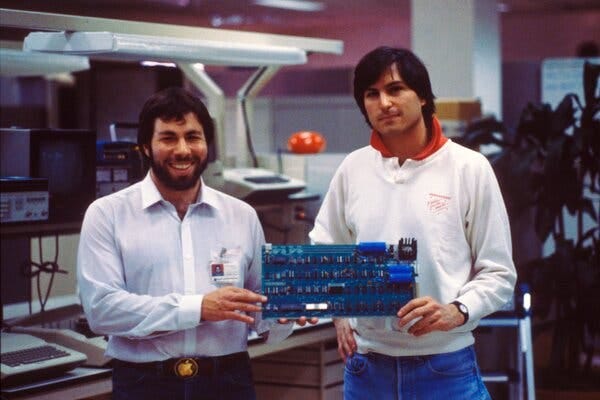
This is the Bigger Picture I’d like to discuss this Sunday. Building on last Sunday’s piece on Apple’s AI distribution strategy taking shape. All kicked off by these two dreamers.
I’m of course on the record that AI is coming just at the right time for Apple, and they’re ready to leverage it. But today, thought it’d be useful to appreciate Apple’s two key characteristics looking back fifty years. Design extraordinary things under existential limitations, and make them available globally at scale. Esoecially thanks to CEO Tim Cook. Relatively under-appreciated in my view vs Jony Ive et al.
Technology products not because it enabled experimental products. But products crafted with hardware and software, that worked backwards to create something that scratched an itch we didn’t know we had.
They did it often focused on the biggest shortcomings of the technology first. A counter-intuitive approach that most tech companies ignore to this day.
The Verge editor-in-chief Nilay Patel covers this well in “Everything is iPhone now”, a piece I’d recommend be read in full this weekend:
“The iPhone changed Apple — and the world — forever.”
“The thing about the iPhone is that everyone knew it was going to be a big deal, and then it was an even bigger deal than that. Hell, it’s still the biggest thing going.”
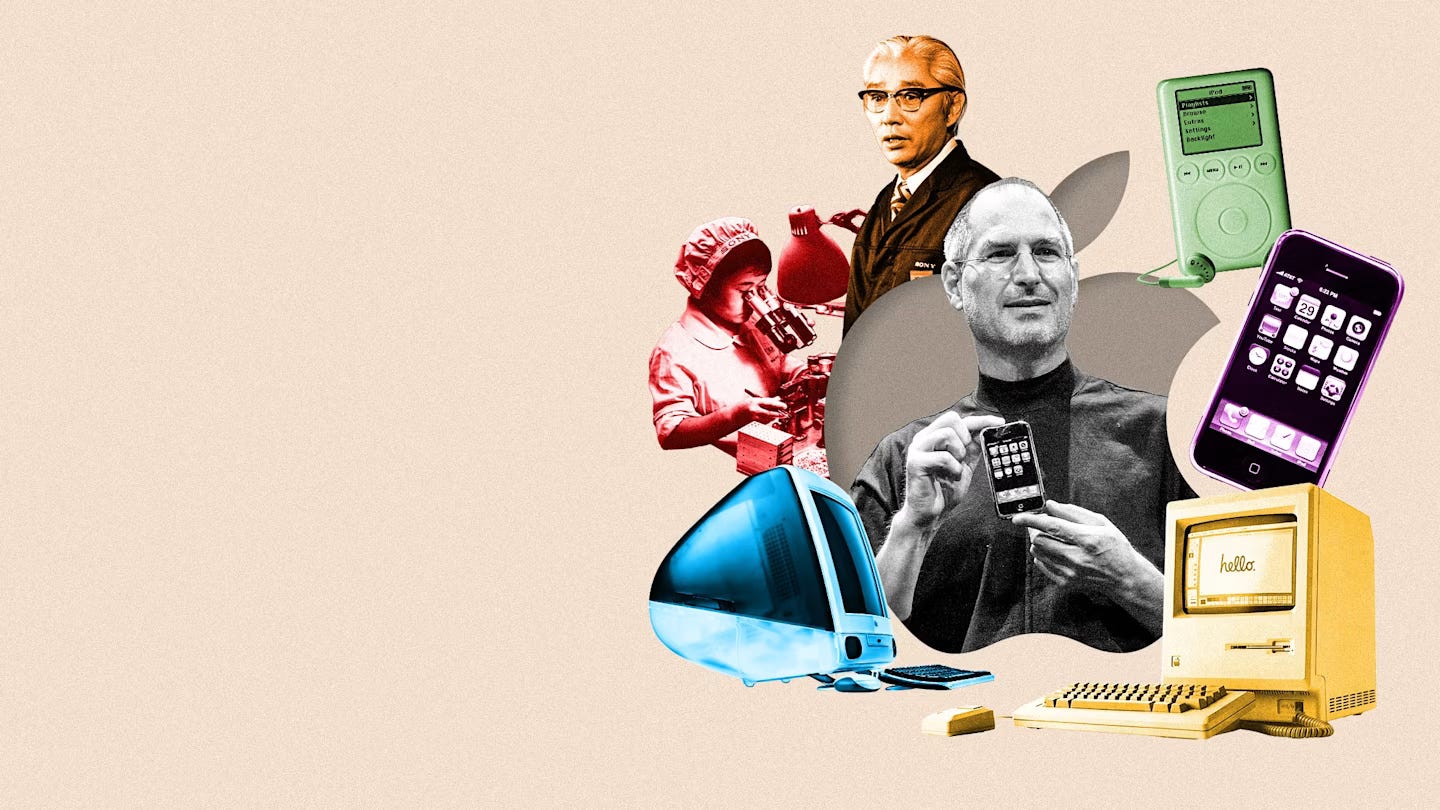
“It’s hard to remember, but almost 20 years ago Apple’s first iPhone really was that good. The trick that Steve Jobs and Jony Ive kept pulling off in that era was turning the limitations of the available technology into focal points of the products they made. The first iMac was built around a big, heavy CRT display — but Ive made the translucent case wrap around it, transforming the internals into a design feature. The iPod was a portable hard drive Toshiba didn’t know what to do with — but Jon Rubinstein and Tony Fadell figured it out, and once Phil Schiller came up with the scroll wheel the design became “inevitable,” as Ive was fond of saying.”
And that carried over to the iconic reveal of the first iPhone in 2007:
“The first iPhone was nothing but limitations, but because Jobs and Apple were so capable of making hard tradeoffs, those limitations became opportunities. There had been an internal battle inside Apple over whether to build a phone on an expanded iPod platform or a cut-down Mac OS X foundation — and when OS X won, the team ruthlessly eliminated features to make it work. Hell, the first iPhone couldn’t even copy and paste, which didn’t arrive until iPhone OS 3.0 two years later.”
“There was no app store, just the apps preinstalled on the device. Apple even built its own Google Maps and YouTube apps to make sure the experiences were exactly what it wanted them to be. All of this meant that Apple was free to focus on making sure the features that did ship were perfect — most notably the multitouch display and the touchscreen keyboard, which were huge risks at the time.”
Which leads to the second biggest Apple accomplishment over fifty years, it’s unique global supply chain under CEO Tim Cook, that willed dozens of extraordinary products into existence in the hundreds of millions per year. With fewest defects possible. You can even rank your favorites here at the Verge.
“Apple’s sheer scale and supply chain excellence operated hand in hand: The company needed to produce millions of new iPhones on schedule every single year, and it did so without so much as a hiccup, a testament to the machine Tim Cook created. That machine produced a technology manufacturing base in China that the world is still scrambling to compete with, and a supply chain that has so commodified the core components of a phone that virtually everything is a smartphone now.”
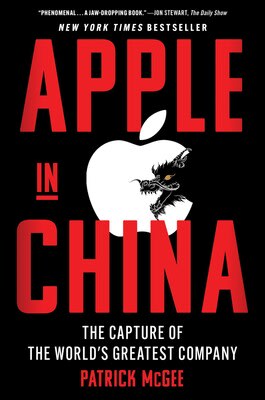
The Financial Times takes a deeper look at the history of this extraordinary supply chain, that saw its roots in post-war Japan, then found its way to China via Japan, Korea and other Asian countries. In another must read piece “Apple at 50: the roots of a tech revolution”, author Patrick McGee notes:
“Apple, which turns 50 years old on Wednesday, is arguably the world’s most iconic company. It is also notoriously opaque and secretive. In virtually all accounts of how Steve Jobs transformed Apple from near-bankruptcy in 1997 to the world’s most valuable company by his death in 2011, product vision and design get all the credit. But what actually makes a $1,200 iPhone possible at global scale with vanishingly few defects is a manufacturing philosophy that traces back not to Silicon Valley or southern China but to war-devastated Japan.”
“This is a story about how ideas travel — across oceans and factory floors, and sometimes through a single person changing jobs. It is a story about how America invented a manufacturing philosophy, exported it to Japan, forgot it, relearnt fragments of it through a handful of companies and then re-exported the whole synthesis to Asia. The story leads us to the present moment, with the US spending vast sums trying to bring it all back, southern India investing to be the next global tech hub and China fighting to hold on to its manufacturing dominance. It is, above all, a story underscoring that what Apple started to build in Shenzhen, China a quarter century ago is not merely an assembly line. It is the endpoint of a multi-decade chain of civilisational knowledge transfer, a feat of enormous complexity that cannot be replicated with tax breaks in Karnataka or a ribbon cutting in Texas.”
So design around limitations, and global, economic production at scale. Those are the key drivers of Apple’s success over the last five decades. And a great formula for the next five.
Welcome back to the Lumida Ledger. If you find this valuable, we’d greatly appreciate you sharing it far & wide with your network. That’s how we grow...