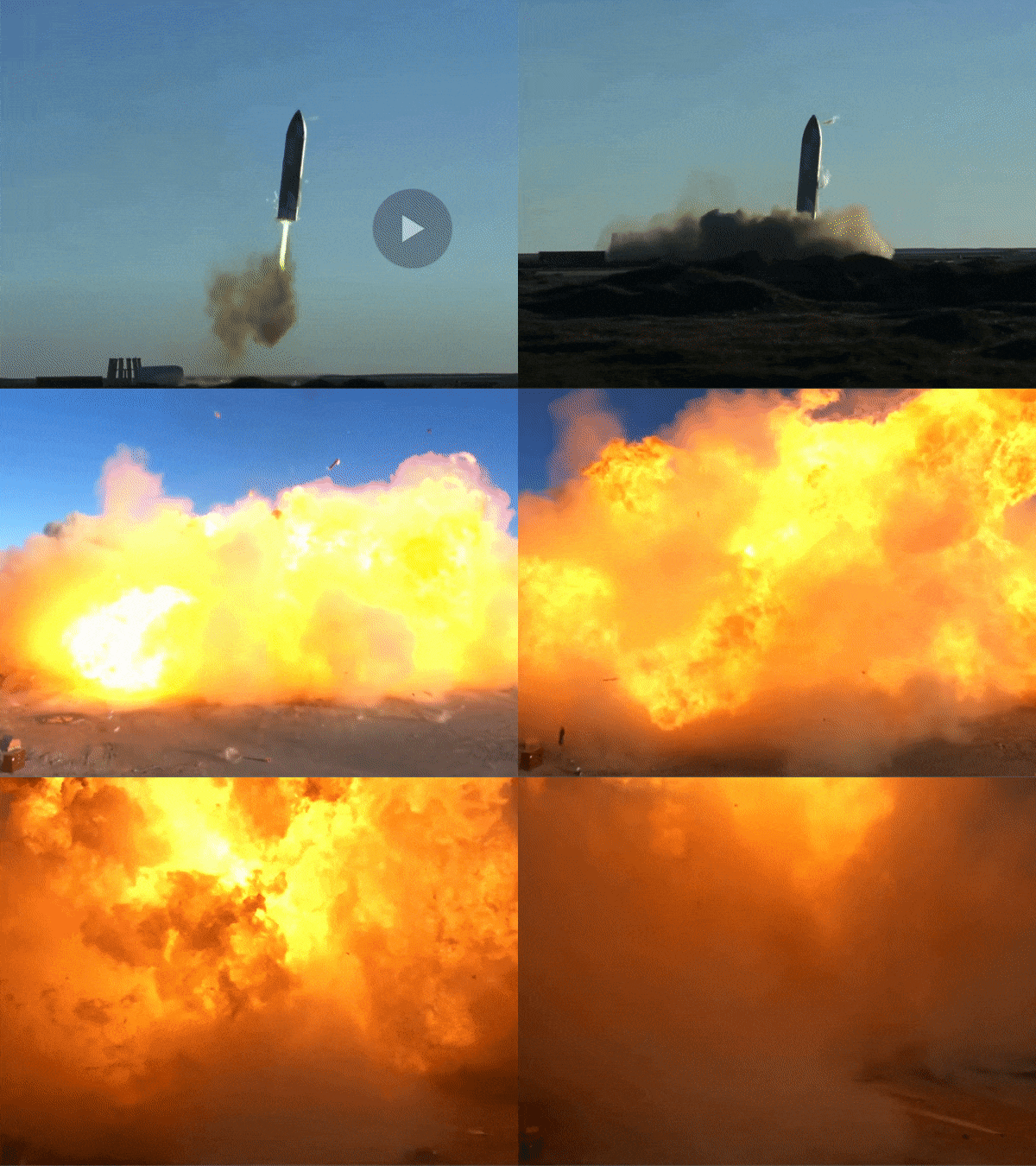
AI: Open Source AI 'Rockets Are Hard.' Nvidia, Reflection & China. AI-RTZ #1164

Nvidia and founder/CEO Jensen Huang have spent a great deal of money and reputational capital of late, trying to build America an open source champion. What this AI Tech Wave keeps teaching us is that the money is only the first step.
The Information details this in “Nvidia Bet on Reflection for Open-Source AI. Now the Startup Is Playing Catch-Up”.
It is a New York AI lab startup Jensen Huang personally pivoted in a new direction.
“Last August, a co-founder of Reflection AI flew to California to meet Nvidia CEO Jensen Huang. The fledgling startup had been making an AI coding tool, but the tech magnate encouraged him to go with a new plan.”
That was eleven months ago. Reflection still has not shipped a model.
“Reflection has yet to actually release its AI model… and it is falling further behind a growing list of rivals.”
The pivot was total. Someone with knowledge of that meeting put it about as bluntly as these things ever get said out loud.
“The co-founders are completely 100% steering the company away from their vision to Jensen’s vision.”
I have been writing about Jensen in this role for a while. Back in March I called him the AI computing ‘Kingmaker’. This is what kingmaking looks like up close on a single company.
And Reflection is only one of four levers he is pulling at once.
He funds. $800 million to start, then 40 percent of Reflection’s $2 billion round in October, then more this year at a $25 billion valuation.
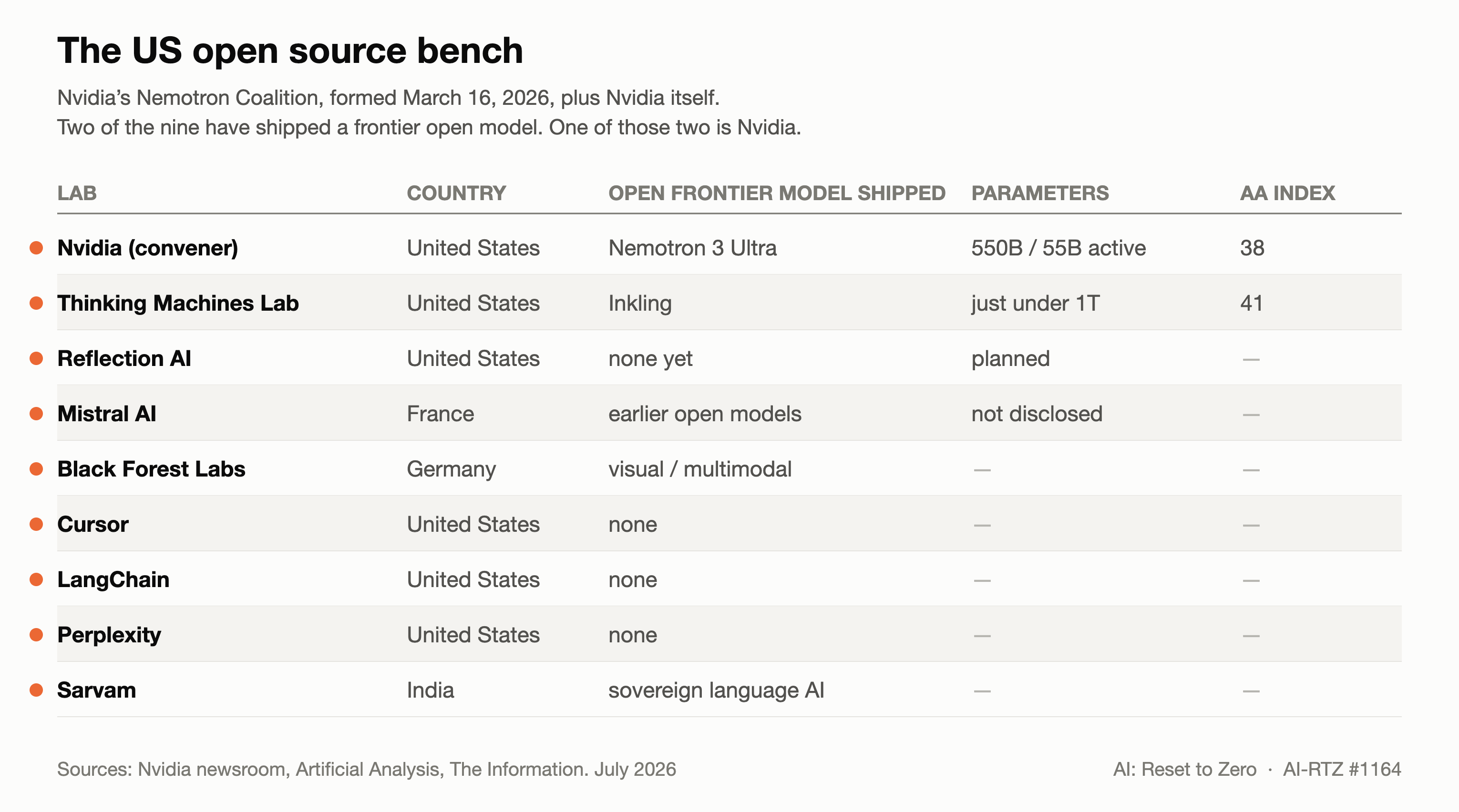
He convenes. In March, Nvidia formed the Nemotron Coalition, eight labs pooling research, data and compute:
He lobbies. On July 24, Nvidia, Meta, Microsoft and 22 other organizations signed a statement backing open weight models. Jensen’s first post ever on X was about it. Open models, he wrote:
“strengthen safety and cybersecurity, accelerate innovation and diffusion, and enable sovereignty.”
And he allies. Earlier this week I covered the AI ‘Avengers’ and the Open Secure AI Alliance he assembled. Back in May I made the case for how Nvidia and Apple could be the US open source champions.
Four mechanisms. One quarterback. Now look at the scoreboard.
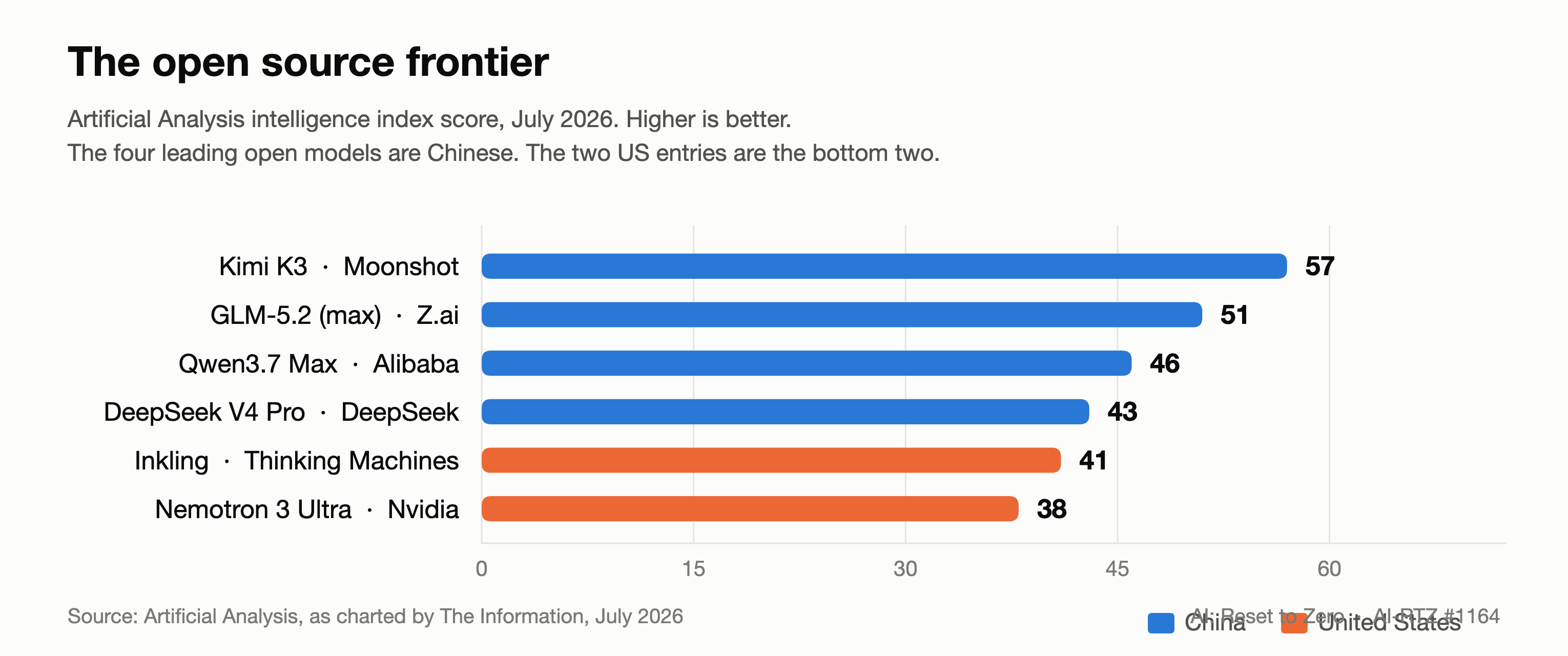
The four leading open models in the world are Chinese. The two American entries are the bottom two, and one of them is Nvidia’s own Nemotron 3 Ultra.
None of this should be new to readers here. I wrote that China leads the US in open source LLM AIs back in June of last year, and have tracked the ramp since.
What is new is the scale.
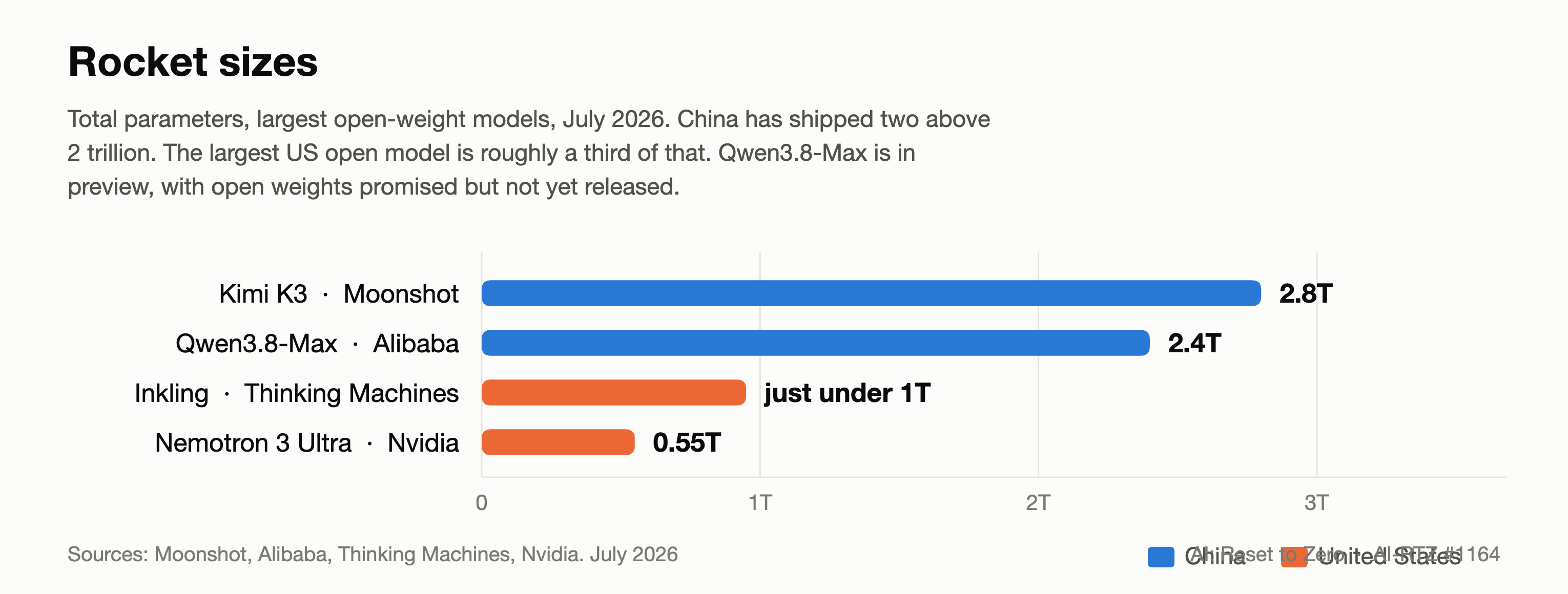
Moonshot’s Kimi K3 shipped this month at 2.8 trillion parameters, the largest open weight model anyone has released. Alibaba previewed Qwen3.8-Max days later at 2.4 trillion, with open weights promised but not yet out.
Those are not clever small models. They are in the same class as GPT-5.6 and Claude Opus 5.
The largest American open model, Thinking Machines’ Inkling, is just under a trillion. Nemotron 3 Ultra is 550 billion.
Which brings me to the line at the end of the Information piece that I cannot stop thinking about. Reflection’s founder/CEO Misha Laskin, talking to CNBC in April:
“These things are hard to build. They’re kind of like rocket ships. And so you can build a small rocket ship, but that’s not really going to impress anyone. To build a big rocket ship, it takes time.”
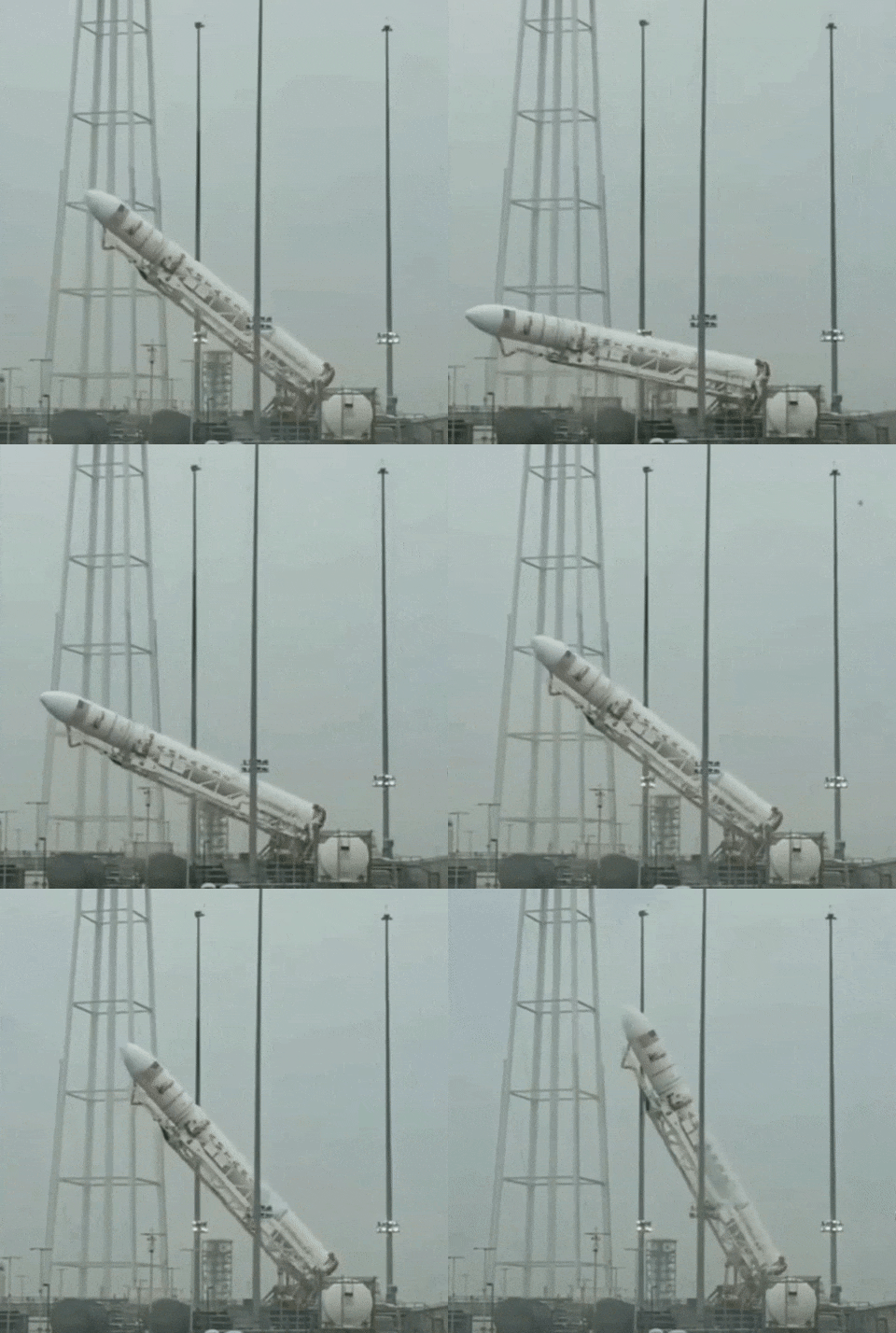
He is right. And the metaphor is better than he likely meant, because we have all been watching a live demonstration of it for years.
Last week I wrote about Elon slowing his Falcon 9 customers to force the Starship transition. Falcon 9 has flown over 650 times. The booster comes back. That took launch costs down by a factor of ten.
And it took Elon over a decade of hard work, lots of literal blow-ups and failures, and super resiliency to get this far.
Falcon 9 first flew in 2010. The first booster they actually landed came down on December 21, 2015. Five and a half years, and a string of ocean crashes and toppled boosters before that one stuck. Add two in-flight losses and a pad explosion in 2016 that took the payload with it.
Then the long part. Over a decade since that first landing, to get from one recovered booster to routine reuse, with single boosters now flying twenty-plus times each.
Not to mention ample government contracts earned and delivered upon.
Starship is a different rocket and it is nowhere near that yet. Thirteen flights since April 2023. Through flight twelve, seven succeeded and five failed. And flight thirteen went up five days ago.
The ship half did everything right. Reached space, deployed twenty Starlinks, relit its engines, came through re-entry and splashed down intact.
The booster did not. Only ten of thirteen engines relit on the way down, five were still running at the water, and it hit hard.
So Starship still has not demonstrated full reusability. Get that right and costs fall by another factor of ten.
Markets have paid Elon handsomely for building big rockets. SpaceXAI carries a valuation north of a trillion and a half dollars on largely that story.
So keep score the same way here.
Kimi K3 is a Starship. Qwen3.8-Max is a Starship. Dubbed ‘super-scale’ AI models with training parameters in the trillions.
Not fully ‘reusable’ yet, in the sense that nobody has proven the economics of giving away a 2.8 trillion parameter model. But aloft with flying colors.
And of course Anthropic Claude/Fable/Mythos/Opus and OpenAI GPT 5.6 are ‘super-scale’ AI Starships. ‘Reusable’ with revenue run rates ((ARRs) into the tens of billions each.
Reflection has not reached the pad.
Inkling and Nemotron are not Falcon 9 either. They are test vehicles. To get a long slew of items worked out and exponentially improved. Then scaled.
I am comparing apples to oranges and I know it. But the shape holds. Rockets are hard. Big rockets are harder. And you cannot wish your way to one.
That last part is worth pondering.
Particularly, because the American answer to Chinese open source is currently a committee. Reflection and Thinking Machines are both members of the same eight-lab coalition. The Chinese models beating them came out of single companies with single founders shipping on their own schedule. As laser focused as Dario, Sam and others here.
I put those names down two days ago, the ‘Six AI Tigers’ of China. Z.ai, founded by Tang Jie and Zhang Peng. Moonshot AI, Yang Zhilin. MiniMax, Yan Junjie. Baichuan, Wang Xiaochuan. 01.AI, Kai-Fu Lee. StepFun, Jiang Daxin. And standing outside that grouping, DeepSeek, out of Hangzhou and funded by a quant fund rather than venture capital.
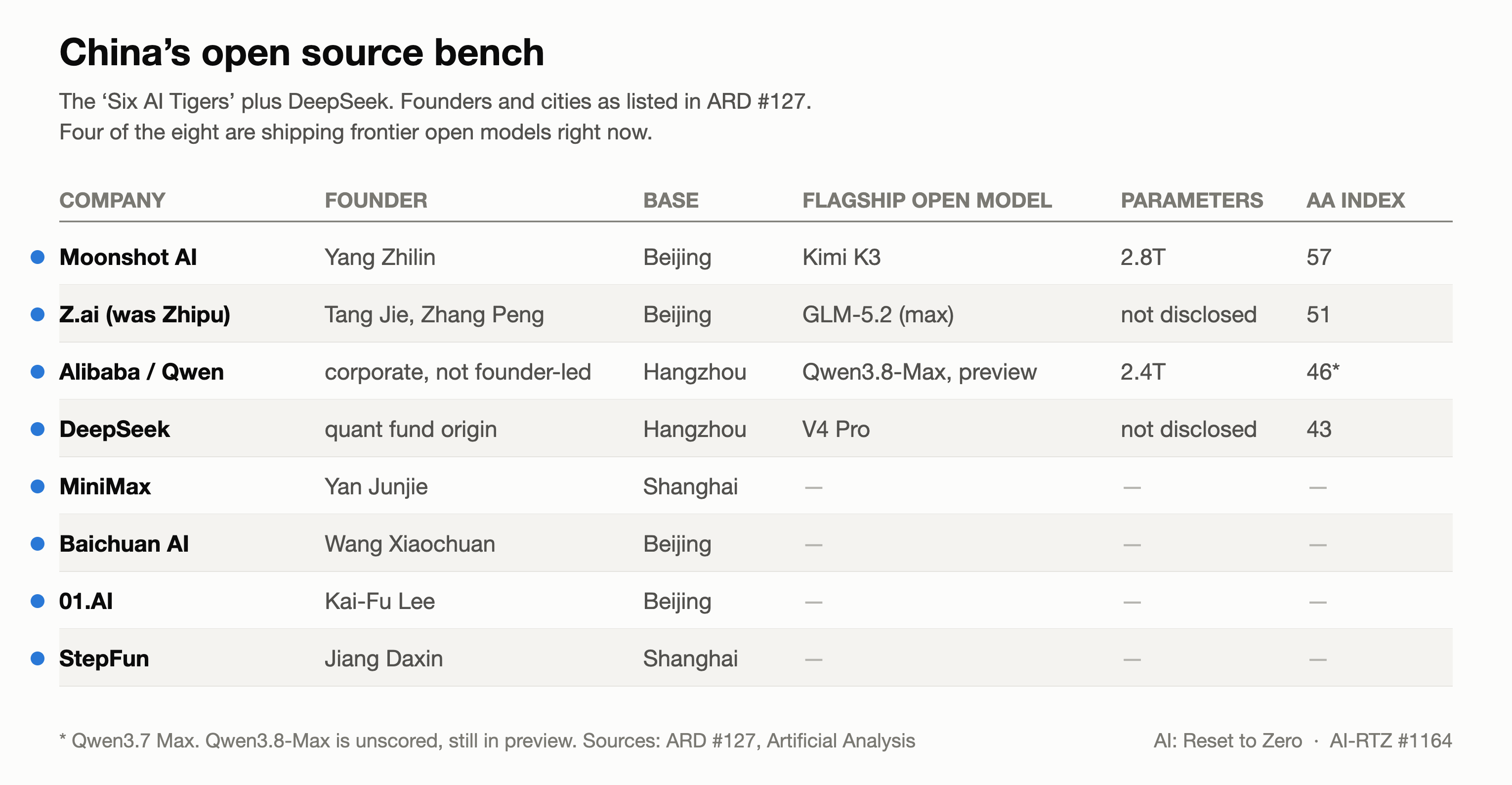
Second act founders, most of them. Not a coalition.
Now the part I find most interesting, and it comes back to governance. Look at who signed that July letter and who did not.
Nvidia, Meta and Microsoft signed. OpenAI and Anthropic did not, and have instead been lobbying Washington to restrict Chinese open source.
Satya Nadella called open weights a path to strengthen American competitiveness. Mark Zuckerberg posted this:
“Open source is a positive and important force for both empowering people and preventing centralization. Proud to support this.”
And Elon, resharing Zuck, wrote simply:
“Overwhelming support for open source.”
That is a notable pair of signatures. Meta walked away from open Llama. Elon has open sourced older Grok versions while keeping the current ones closed. Both are hedging.
Here is my Take.
Zuck and Elon are two of the most pragmatic and resilient founder CEOs in this business. Neither has yet found a proprietary model business that pays for the compute they are buying.
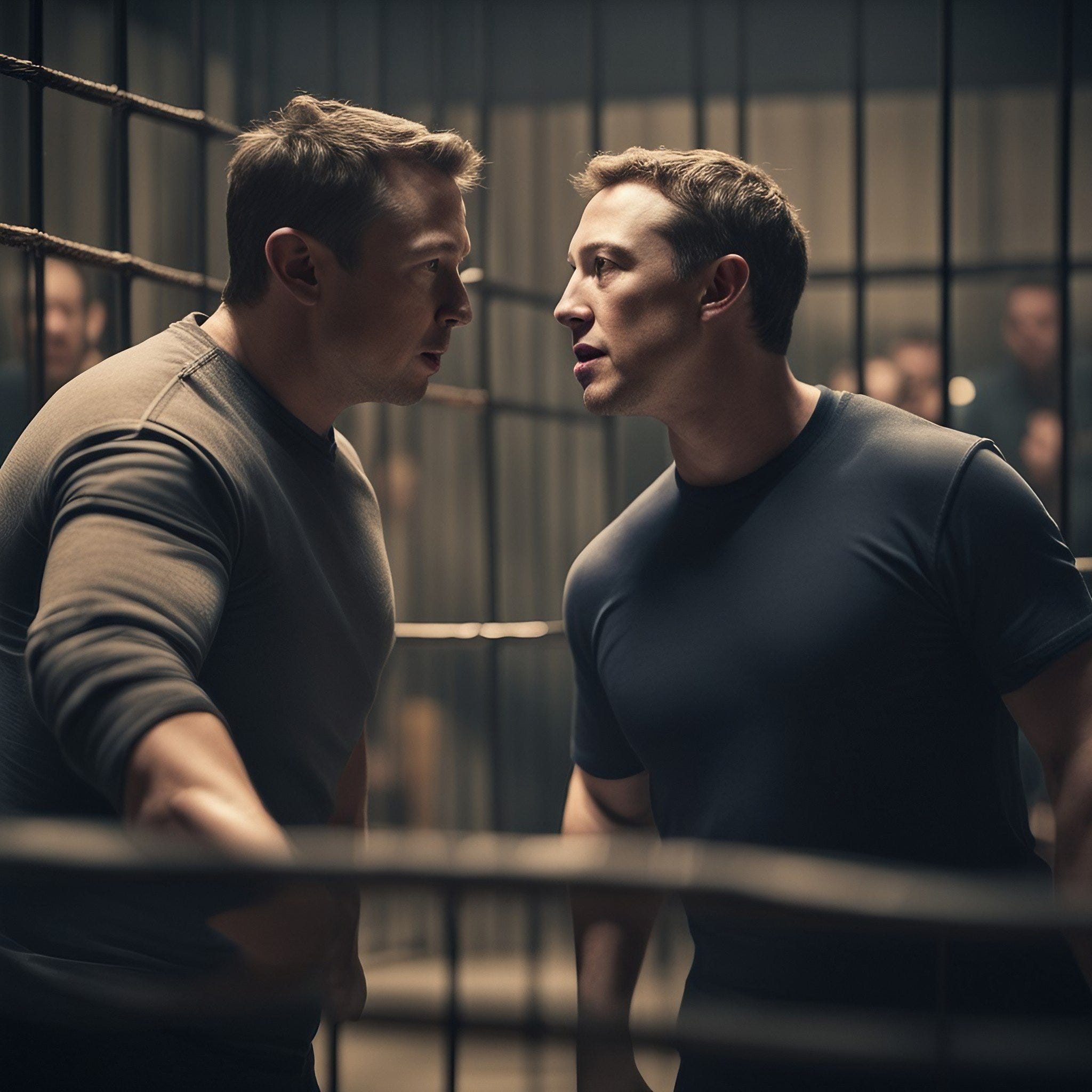
Meta’s free cash flow last quarter was $784 million. Against $31 billion of capex in the same three months.
If the proprietary economics do not close, open weights stop being a philosophy and start being a strategy.
I would not be surprised to see Meta steer Muse Spark back toward open, the way Llama used to be. Or Elon do the same with a future Grok. Both have the compute. Neither has the model economics.
Alibaba is running the same straddle, and they are worth watching because they are the one Chinese player big enough to have the choice.
Their heart says open, because open is the market share strategy. Their head says closed, because closed is where the serious money is. Qwen3.8-Max sits in preview with the weights promised and not delivered.
That tension has already cost them people. In March, Junyang Lin, the technical lead behind Qwen, was out. He posted four words about it.
“me stepping down. bye my beloved qwen.”
A colleague said the part Alibaba did not.
“I know leaving wasn’t your choice.”
But here is the distinction that matters, and it is the one I keep coming back to.
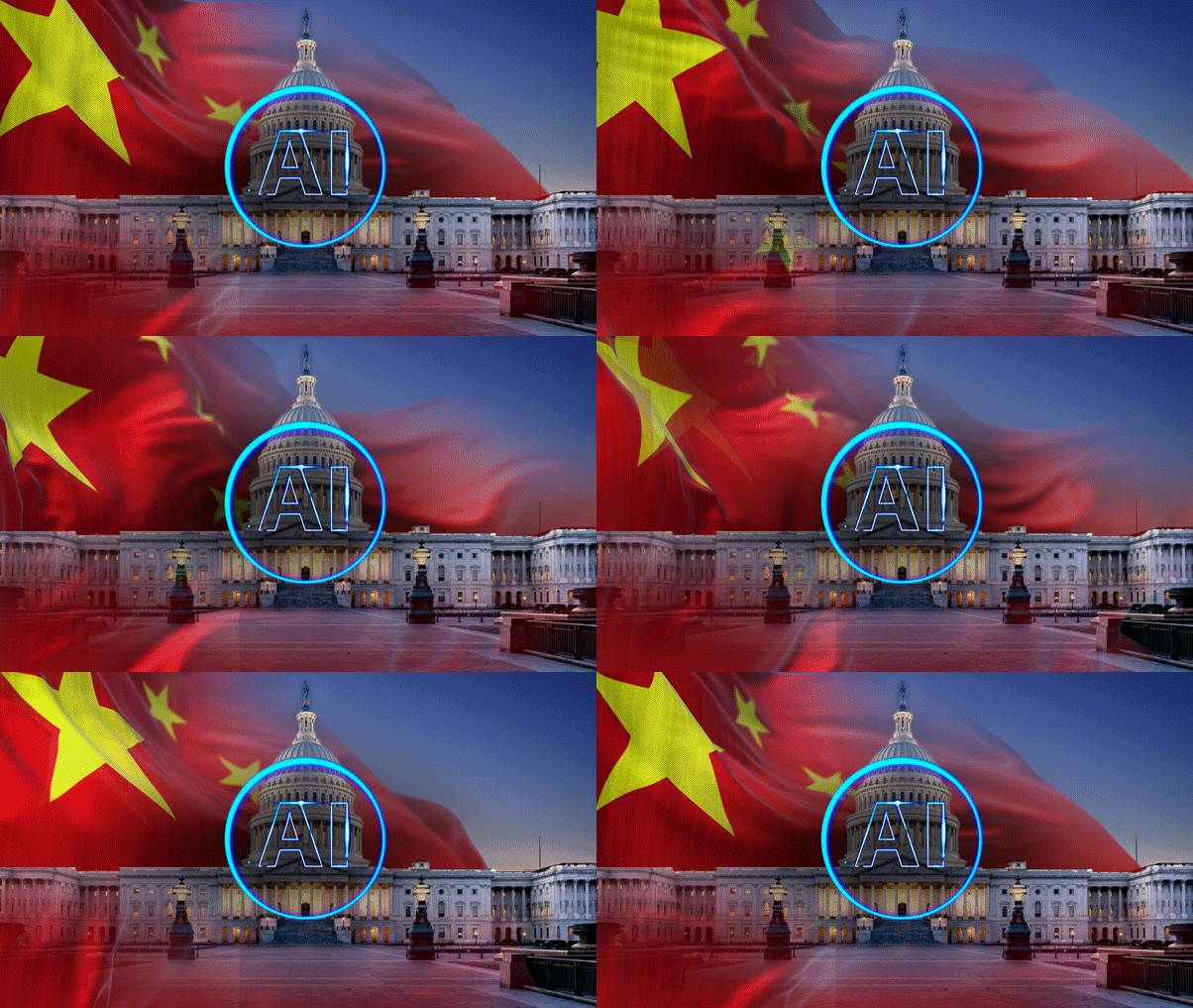
For the Chinese model companies, open source is not a philosophy. It is the only route they have.
They do not have the needed gobs of the latest AI chips and compute. They do not have a domestic commercial market large enough to monetize a closed frontier model the way Anthropic and OpenAI are doing here. So global usage is the strategy, because global usage is the only strategy available to them.
American labs have no such constraint. Which is exactly why ours can afford to hedge and theirs cannot.
And even then, open is a spectrum rather than a switch. Kimi K3 launched on July 16. The weights did not land until July 27, eleven days later, at 1.4 terabytes. Open enough to validate. Heavy enough that almost nobody can actually run it.
Which leaves the American open source bench looking like this. A chip vendor funding everyone. A committee of eight. And two founder CEOs keeping their options open while they figure out whether closed pays.
Against six Chinese companies and a quant fund ‘DeepSeek’ that just shipped.
This AI Tech Wave rewards the builders who stay on the pad long enough to launch, not the ones with the best convening power.
Rockets are hard. AI Rockets likely as hard or harder.
The ones that fly are the ones somebody has been building for years, on their own schedule and cost/revenue trajectories. Stay tuned.
(NOTE: The discussions here are for information purposes only, and not meant as investment advice at any time. Thanks for joining us here)


