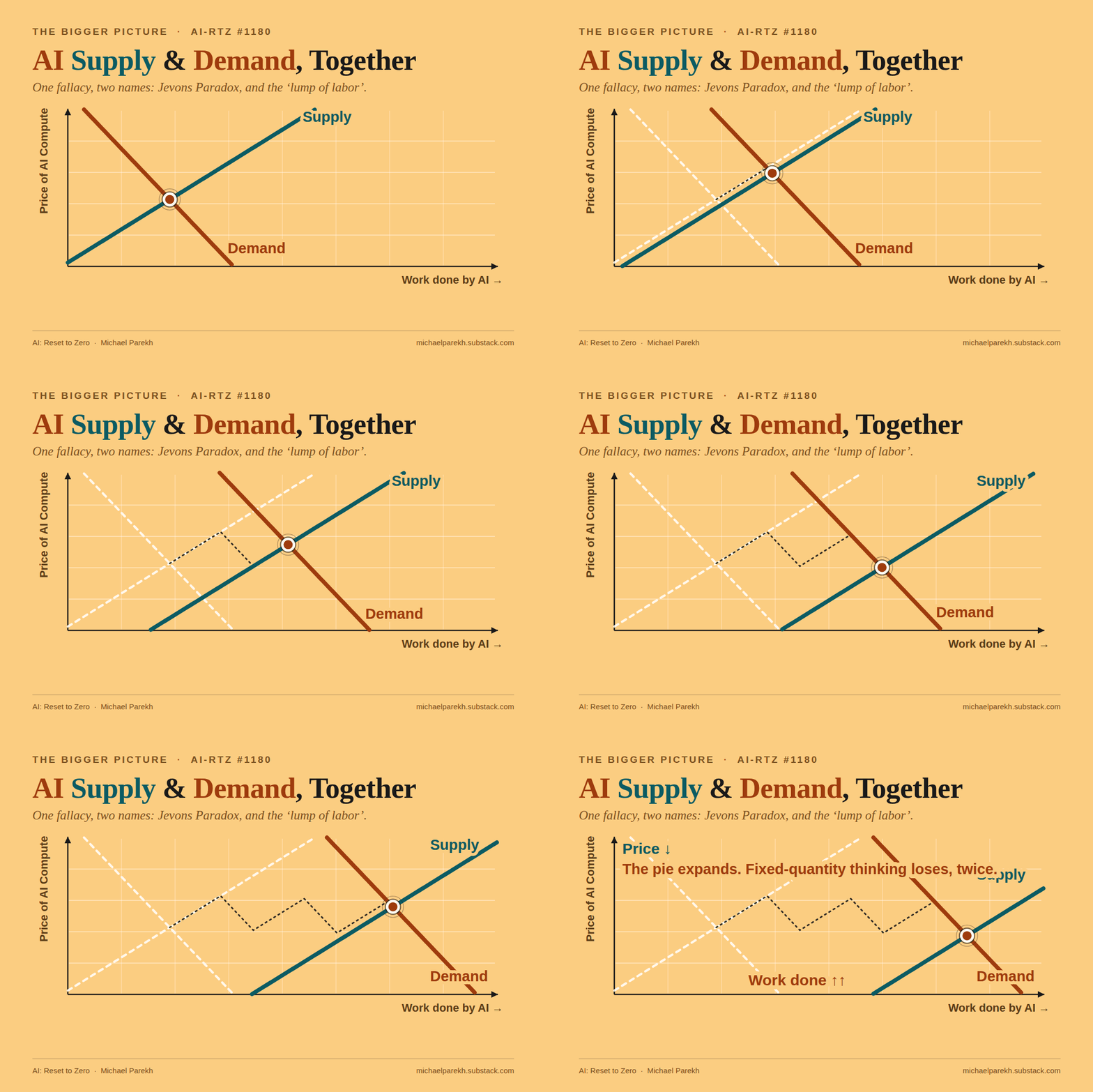
AI: Supply & Demand Together in the AI Tech Wave (part 4). AI-RTZ #1180

The Bigger Picture, Sunday, August 16, 2026
We have emphasized through this AI Tech Wave that the most important economic debates in AI keep coming back to one question: what does demand do when the price of a thing collapses, or when the supply of a thing explodes? Let’s unpack in this Sunday’s ‘Bigger Picture’.
Part 1 of this series, last Sunday’s Bigger Picture, was the SUPPLY side: who is building the Gigawatts, and who actually pays. We used Elon Musk/SpaceXAI as Exhibit 1.
Part 2 was the DEMAND side: the ‘Dwarkesh’ compute bull case, and its ten brakes. It’s AI podcaster Dwarkesh Patel’s AI ‘thought experiment’ that provoked reactions across the industry.
Part 3 this Friday brought it down to ground level: the near-term compute crunch, with rental prices resetting upward and neoclouds auctioning scarce capacity.
This part 4 brings the two sides together going forward. It combines the two loudest debates in AI right now, what AI does to JOBS, and what AI does to AI COMPUTE PRICES.
In terms ranging from hardware (GPUs/Memory chips, data centers, power etc.), to software (closed vs open etc.) across countless models, from largest to smallest.
Both are being debated with two different named and long researched and disproven fallacies by Economists and Mr. Market. And they are the same fallacies around notions of fixed vs expanding pies. With up and down prices for new AI hardware/software capabilities.
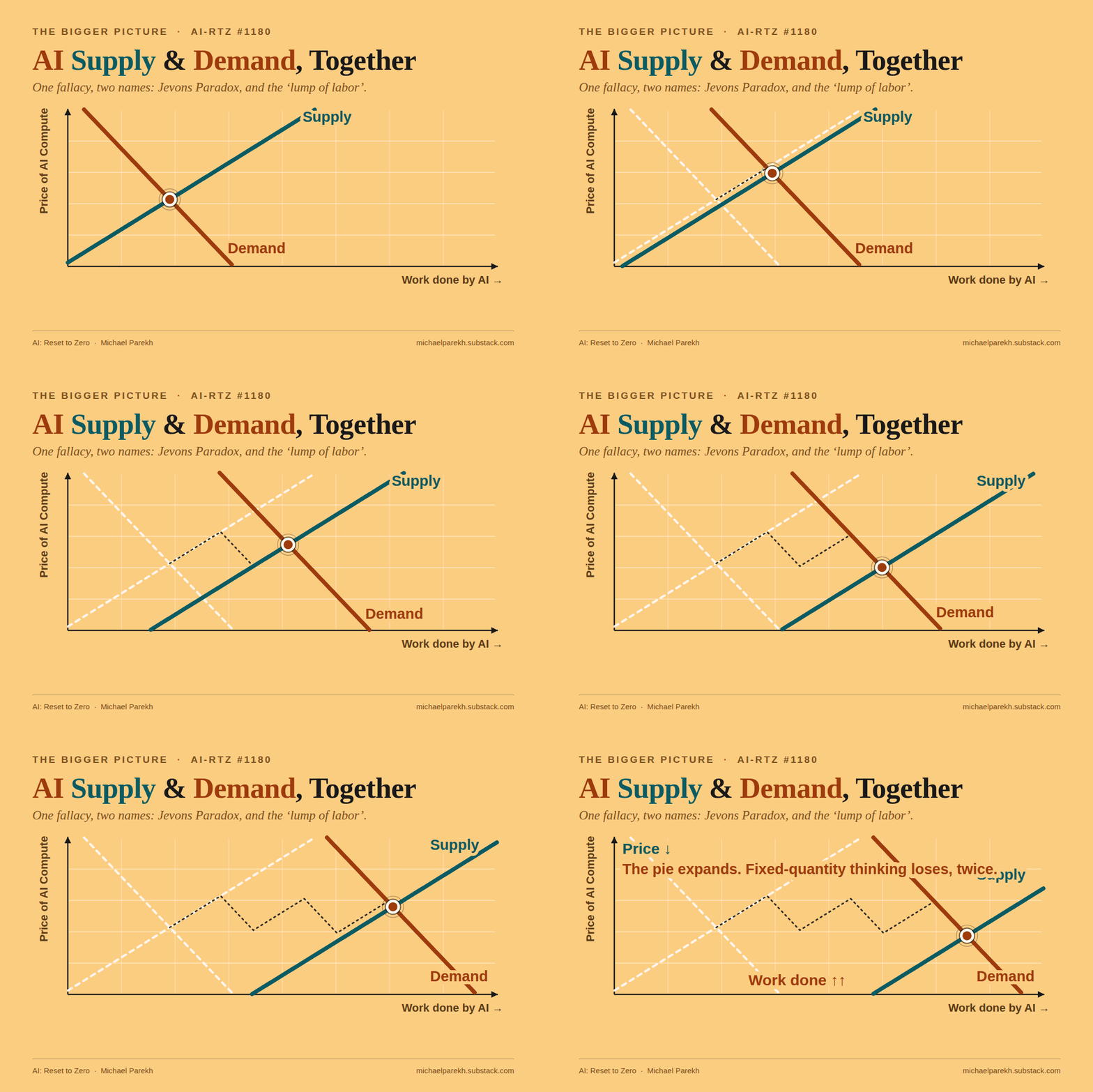
The animated chart up top compresses the whole argument into one motion. Both curves keep shifting out together: supply pushing out to answer price umbrellas, demand pulling forward as intelligence gets cheaper. The intersection dot saws up and down along the way, the near-term price spikes and crunches we covered in part 3, even as it works its way steadily down and to the right over time.
Prices will keep swinging in wide pendulums, as we move through successive AI model and hardware architectures.
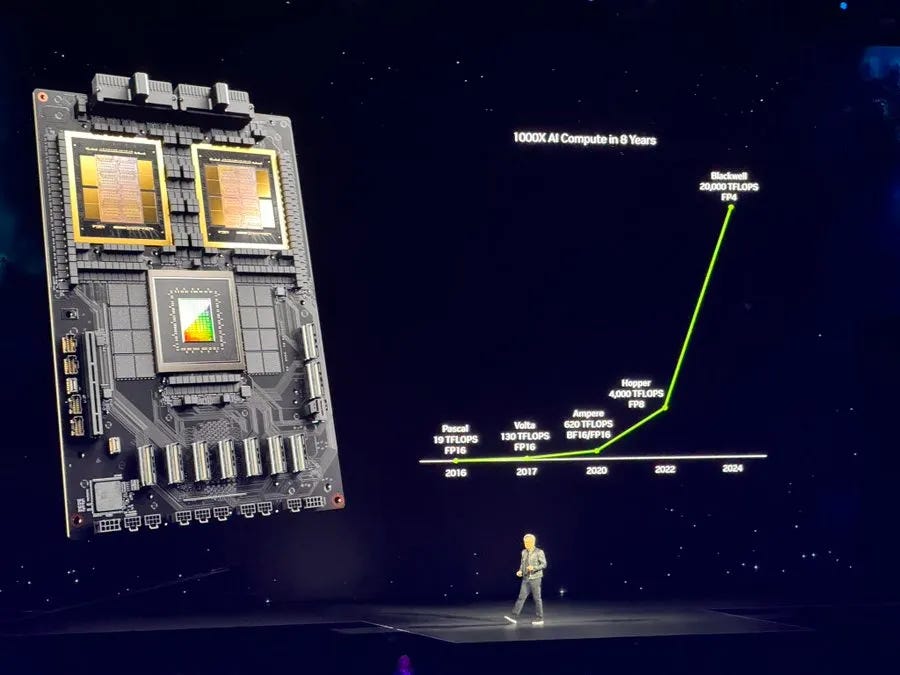
But the direction of travel is one way: more work done by AI, at lower prices, in an expanding pie. Fixed-quantity thinking loses, twice. All driven by ever improving AI capabilities at scale, driven at magnitudes beyond Moore’s Law, for now.
The two Economic frameworks:
-
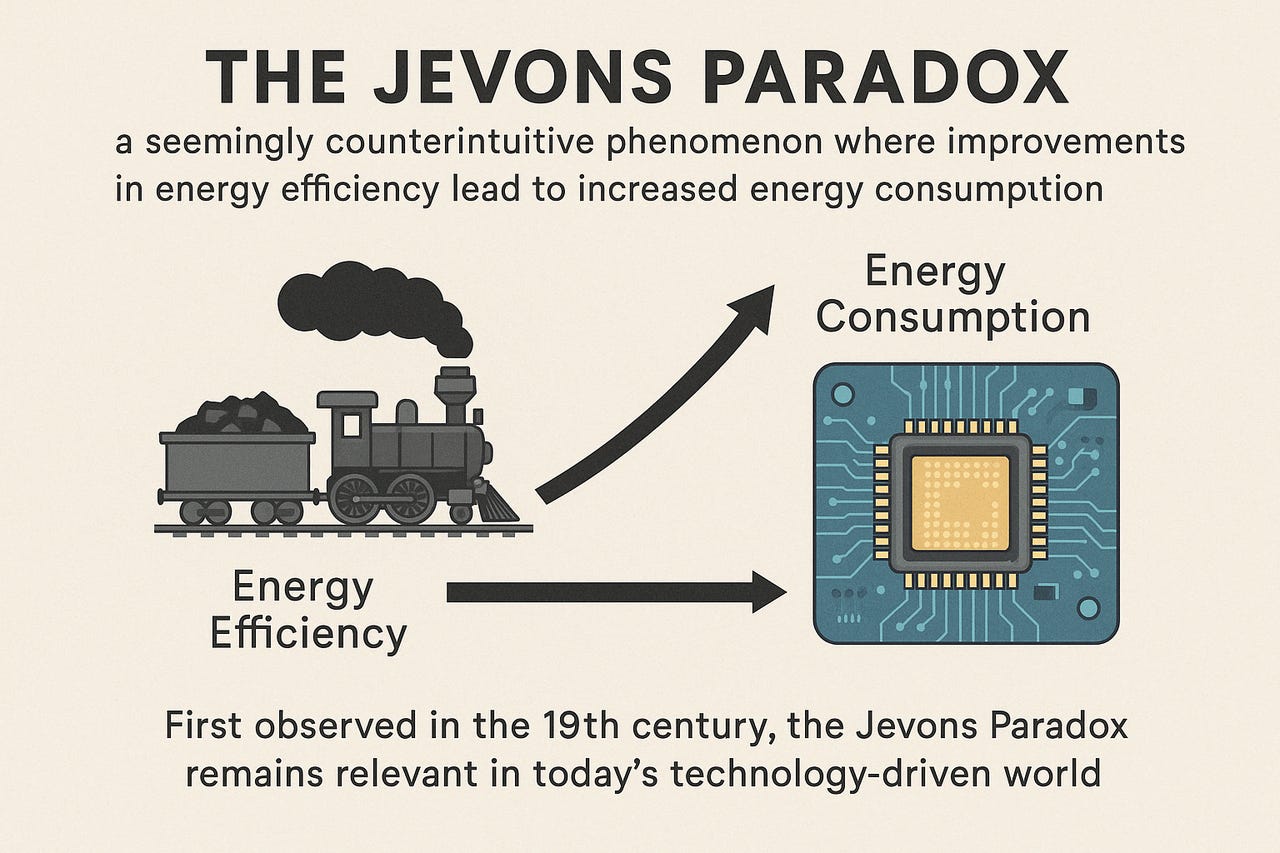
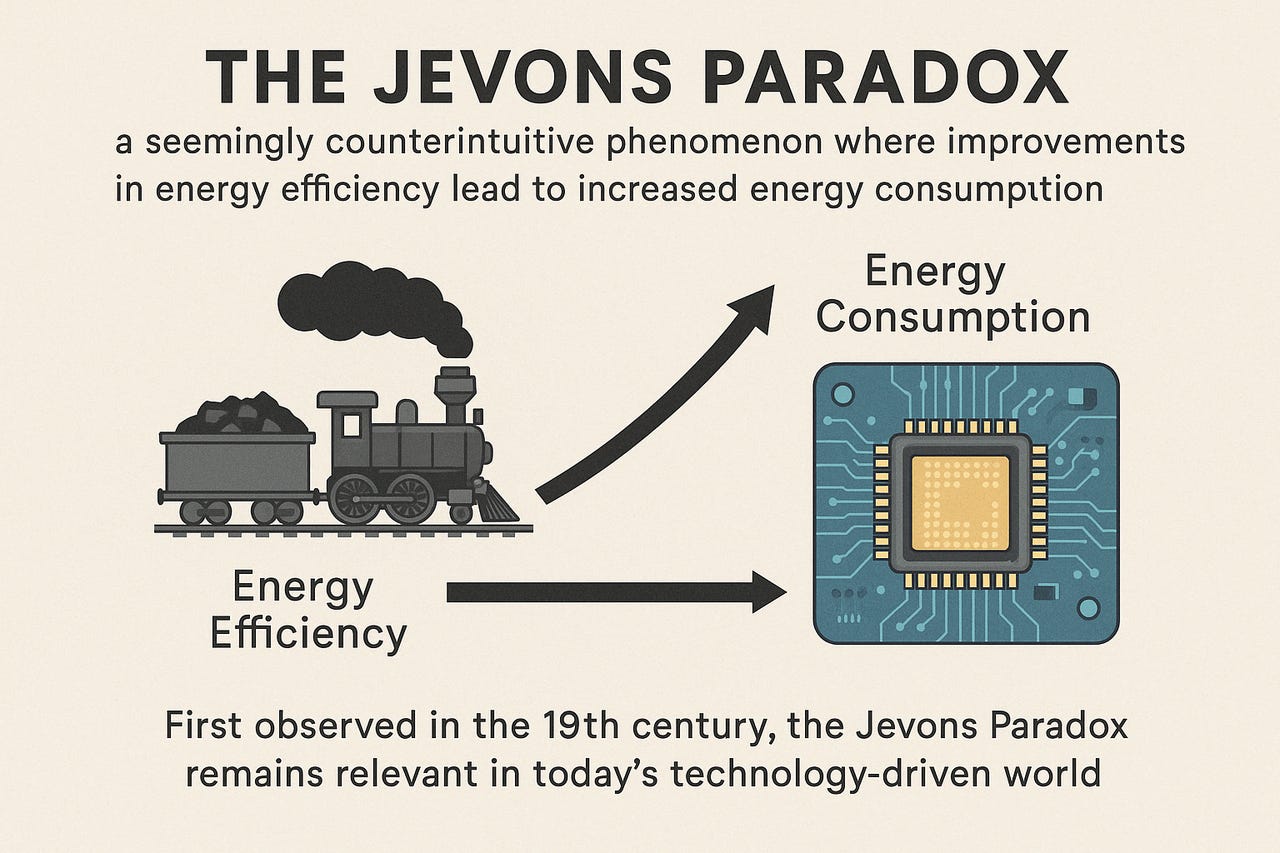
The Jevons paradox. William Stanley Jevons, 1865, watching England’s coal: make an engine more efficient, and coal use goes UP, not down, because efficiency drops the effective price and demand more than answers. Microsoft’s Satya Nadella invoked it by name the weekend DeepSeek cratered AI stocks: make intelligence cheaper, and the world consumes far more of it. The formal economics lives under the ‘rebound effect’ literature in energy economics, where a rebound past 100 percent, consumption rising on efficiency, is called ‘backfire’. Jevons is the patron saint of backfire.
-
The ‘lump of labor’ fallacy. The centuries-old error of assuming there is a fixed amount of work in the world, so any new worker, immigrant, machine, or AI agent, must take an existing worker’s share. Economists have spent decades documenting why the lump is a mirage: new capacity changes prices, prices change demand, demand creates work nobody had priced.
The true result and mistake of both the above: The overall pie EXPANDS. Not contract, as assumed by most mainstream observers. At first glance.
Look at the structure of the two arguments side by side.

Both start with the same wrong assumption: that the quantity demanded is FIXED, of work in one case, of energy or compute in the other. Both break for the same reason: price moves, and demand moves with it, usually much further than intuition allows. One economic fallacy, two names for different versions of the same.
Why this matters for AI, twice over
On jobs, the doomer case is ‘lump-of-labor’ in a trench coat:
AI agents do the work, therefore the work is done and gone. Forever.
Like cars replacing horses after the historical peak demand for horses was achieved. Forever.
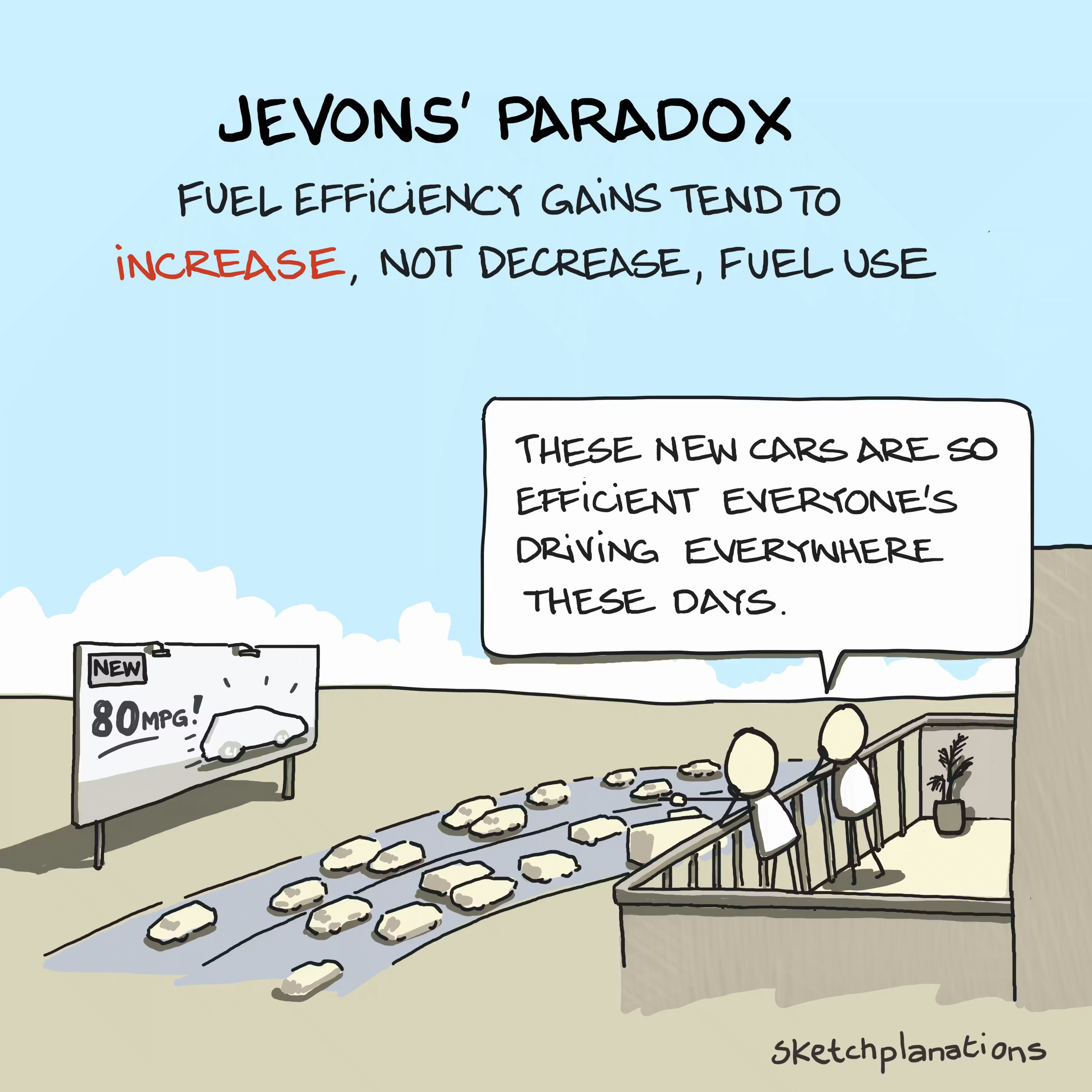
But the Jevons Paradox frame says the price of a unit of white-collar output is collapsing, and collapsed prices summon demand never modeled. Because the real examples didn’t yet exist.
New demand is created at prices lower than the market had ever seen.
The way cheap compute summoned workloads no mainframe planner imagined.
The way more electricity supply in a home, initially for refrigerators and air conditioners, expands for microwaves, air fryers and Roombas.
New conveniences invented because the electricity was made available at ever lower prices and higher quantities, as the generation infrastructure expanded more than ever envisioned in its early days.
A recent Fortune piece ran the two frames side by side on exactly this question, and older commentary has teased the same symmetry. The honest answer is that the fallacy CAN hold locally and short-term, which is where the Gen Z hiring pain is real, while breaking utterly at the system level over time.
But that too is shifting, as I wrote about a few days ago.

On compute, the richest irony: Dwarkesh Patel’s compute bull case, which we addressed brake by brake in AI-RTZ #1174, is Jevons Paradox applied to compute. Efficiency gains summoning MORE total compute spend.
Argued by the same corner of the AI world that correctly dismisses ‘lump-of-labor’ on jobs. He even cites the ‘lump of labor’ fallacy himself, for AI engineers.
Ironically, the AI Compute bulls are running one economic fallacy’s cure as the other side’s disease. If demand is elastic enough to rescue jobs, it is elastic enough, on the supply side, to answer price umbrellas with capacity, as we argued in the Race to Zero and the ‘Local AI’ stage pieces.
Every revolution shows Economics lagging Tech
The abstract point has a concrete history, and we have written about these historical rhymes before. Every major economic disruption of the last two centuries ran the same double panic.
The industrial revolution was going to run out of work for weavers, and out of coal for engines: Jevons wrote his paradox about the second while the first was proving false. The railroads were catastrophically overbuilt, and the crash of the late 1800s handed the economy something better than the railroads’ profits: cheap freight. Which built everything from Sears catalogs to steel towns. America in other words.
Electricity, the other key input besides GPUs then as now, took forty years to show up in productivity statistics because factories had to be rebuilt around it. Computing ran the mainframe-to-PC-to-smartphone tech stack staircase, with every stage declared the last one that would ever need more compute. To AI today.
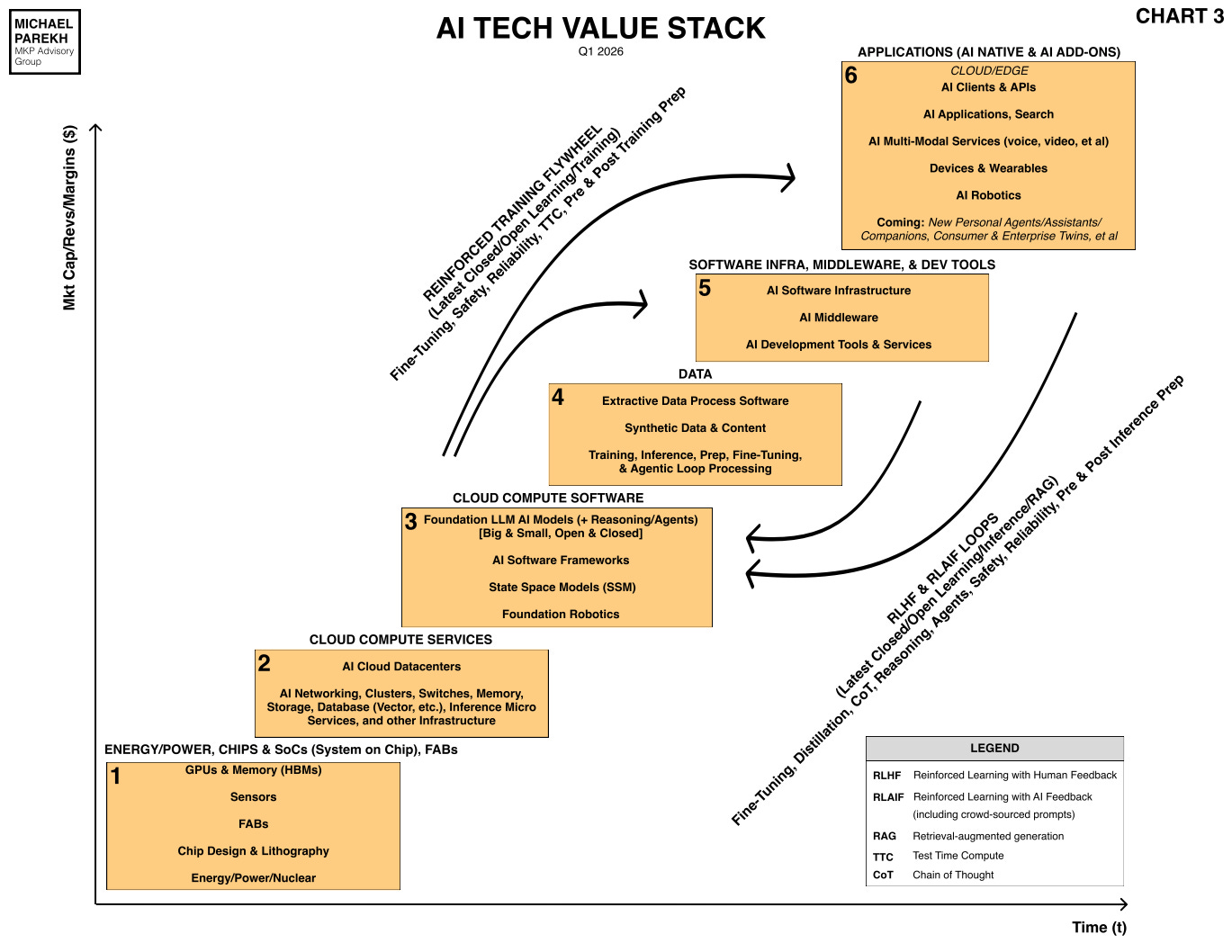
And the internet gave us the fiber glut of 2001, capacity built for a demand curve that arrived five years late, and then ate all of it, and more.
And note who is always late to the party: the economists. Jevons published in 1865, a century after Watt. The rebound literature that formalized him dates to the 1980s. Robert Solow quipped in 1987 that you could see the computer age everywhere but in the productivity statistics, and the statistics only caught up in the late 1990s.
They’re late not because they don’t ‘get it’. But because there are not enough relevant data points for a long time as technology advances, at necessary scales to measure.
Economic analysis lags the technology, and its impact on the global economy, in every single one of these waves. Especially in the early stages where the infrastructure gets built at huge expense.

It is lagging again now, which is why the best arguments in AI economics are still being had on podcasts and Substacks rather than in the journals, and why we have been making this point in our own writing and podcast appearances all along.
The lag IS the opportunity, for those willing to be roughly, but directionally right early.
My Take
Jevons Paradox and the ‘lump of labor’ are the same economics lesson taught twice: fixed-quantity thinking always loses to price-elastic reality. The pie expands. Not a zero sum game as initially assumed.
Applied consistently, it says AI does not run out of work to do, and compute does not stay scarce at any price the bulls pencil in. And the accounting arguments the bears make on depreciation curves.
You cannot invoke the fallacy on Mondays for labor and forget it on Tuesdays for compute.
That is what ‘supply and demand together’ means for the AI Tech Wave going forward: the supply side answers price umbrellas with capacity, the demand side answers cheap intelligence with appetites nobody modeled, and both sides embarrass anyone holding the quantity fixed.
The revolutions before this one, industrial, railroad, electricity, computing, internet, all settled in the same place. This one is simply doing it faster, with a lot more zeroes. That is why the Bigger Picture today, is truly the framework to use for the AI Tech Wave ahead. Stay tuned.
Sources: the first three parts
-
AI: Elon’s Mega AI Data Center Supply Ambitions (part 1). AI-RTZ #1173
…the ‘Gigawatt AI Gold Rush’, with frontier labs paying Elon ~2x compute market prices, for now.
-
AI: The ‘Dwarkesh’ Compute Demand Bull Case (part 2). AI-RTZ #1174
…compute 10x pricier? The mega-bull case laid out, and my ten brakes on tempered prices.
-
AI: The AI Compute Crunch at Ground Level (part 3). AI-RTZ #1178
…Nvidia’s 2022 H100 rents up 50%, Neoclouds CoreWeave & Nebius cash in, & AI startups squeezed near-term.
(NOTE: The discussions here are for information purposes only, and not meant as investment advice at any time. Thanks for joining us here.)


