
AI: Why Google is still in Consumer AI pole position. AI-RTZ 1096

The Bigger Picture, Sunday, May 24, 2026
After this year’s Google I/O Developer conference this week, I called and outlined Google out as the most likely winner of the Consumer AI opportunity in this ‘mainframe’ phase of the AI Tech Wave. Especially as OpenAI and Anthropic are now chasing the Enterprise/Developer market in earnest.
To be clear, I’ve been calling Google as a big AI winner for three years now, when the consensus view was its inevitable fall to OpenAI and ChatGPT over four years ago. But the Bigger Picture I’d like to focus on this Sunday, is why Google has a clear shot on the consumer AI side in the next two to three years.
Along with Apple of course as I’ve also outlined. Let’s unpack.
Axios starts to lay out the opportunities and concerns, in “How Google plans to win the AI war”:
“Google is trying to pull off one of the trickiest balancing acts in tech: aggressively disrupting its own products with AI while protecting the businesses that generate tens of billions in profit.”
That has been and is the biggest question still on investor minds. How does Google grow its AI business vs native AI rivals like OpenAI and others, while preserving the billions in traditional Search advertising revenues that make up its current unprecedented global franchise.

“Why it matters: Unlike OpenAI and Anthropic, Google enters the AI race with enormous scale, distribution and cash flow — but also a vast empire it has to defend.”
“Driving the news: As it has for the past two years, Google used this week’s I/O developer conference to focus almost entirely on AI.”
“It’s revamping its core search box to serve both traditional short queries, while seamlessly allowing it to expand for longer chatbot-style conversations.”
“YouTube, meanwhile, is getting a new “Ask YouTube” feature where people can ask a question and get both a text result — for making a recipe, say, or fixing a clogged pipe — as well as a link to the video.’“
The world still keeps changing its mind on Google, like viewers at the US Open rapidly see-sawing this heads back and forth.
“The big picture: Public perception of the AI race often swings wildly based on whichever company most recently released a flashy model.”
“For a while OpenAI was seen as unbeatable. Then late last year, Google was seen as having pulled ahead. And now many are pointing to Anthropic as having surged forward thanks to Mythos.”
“But executives at Google, OpenAI and Anthropic increasingly describe the frontier race as effectively neck-and-neck, with companies making different tradeoffs around cost, speed and computing resources.”
“This was highlighted by Google’s choice to debut the latest Gemini not with a behemoth version to compete with Mythos but with the faster, cheaper Gemini 3.5 Flash.”
“The choice reflects a broader Google strategy: Stay at the frontier, but also prioritize models cheap and fast enough to deploy across products used by billions, rather than chasing benchmark supremacy alone.”
“In other words, Google’s key advantage may be in not just competing for the best model, but being able to pair that leading model with enormous platforms that dwarf even ChatGPT in scale.”
Core here is Google’s vertical stack powered by its in house TPU processors, that give it massive amounts of affordable global AI compute to offer the above fast Gemini models far more wider and deeper than its AI native peers.
Google is certainly not acting like its won anything at all thus far.
“What they’re saying: “The competition is fierce,” Google CEO Sundar Pichai said Tuesday during an on-stage interview with Future Forward’s Matthew Berman. “A few labs are really at the frontier and then there’s a big gap.”
“Zoom in: A strong existing business is helping Google invest upward of $180 billion in capital expenses this year — up sixfold from 2022 — without having to constantly raise money in the ways its rivals do.”
“Plus, having so many products allows Google to test a lot of things at scale and spread out the costs of developing state-of-the-art models.”
“One of the cool things we get to do here at Google is build technologies that get immediately deployed into multibillion-dollar products,” Google DeepMind CEO Demis Hassabis told Axios in an interview Tuesday. “It’s pretty, pretty exciting, and I would say pretty unique.”
But investors will continue to gnaw at the question of the existing business.
“Yes, but: Adding AI everywhere risks not only making the products more complicated for users, but disrupting Google’s highly lucrative business model.”
“If people get the answer they want from search directly, they may be less likely to click on an ad.”
“Letting people ask questions of YouTube videos could mean fewer people are watching the full videos — and the ads within, potentially making YouTube less attractive to creators in addition to less lucrative to Google.”
“Meanwhile, ads within chatbots are still in the experimental phase, though Google announced some new tests at I/O and OpenAI is also charging forward, saying it sees AI ads as a $100 billion business by 2030.”
“The bottom line: Google is betting it can do what few incumbents manage: reinvent its core products fast enough to survive the next platform shift while still funding the transition from the old business.”
That sums it up in a relative nutshell.
Despite the above concerns, in my view, Google still has a clean shot at being a sweeping winner in the coveted Applications & Services Box 6 of the AI Tech Stack below.
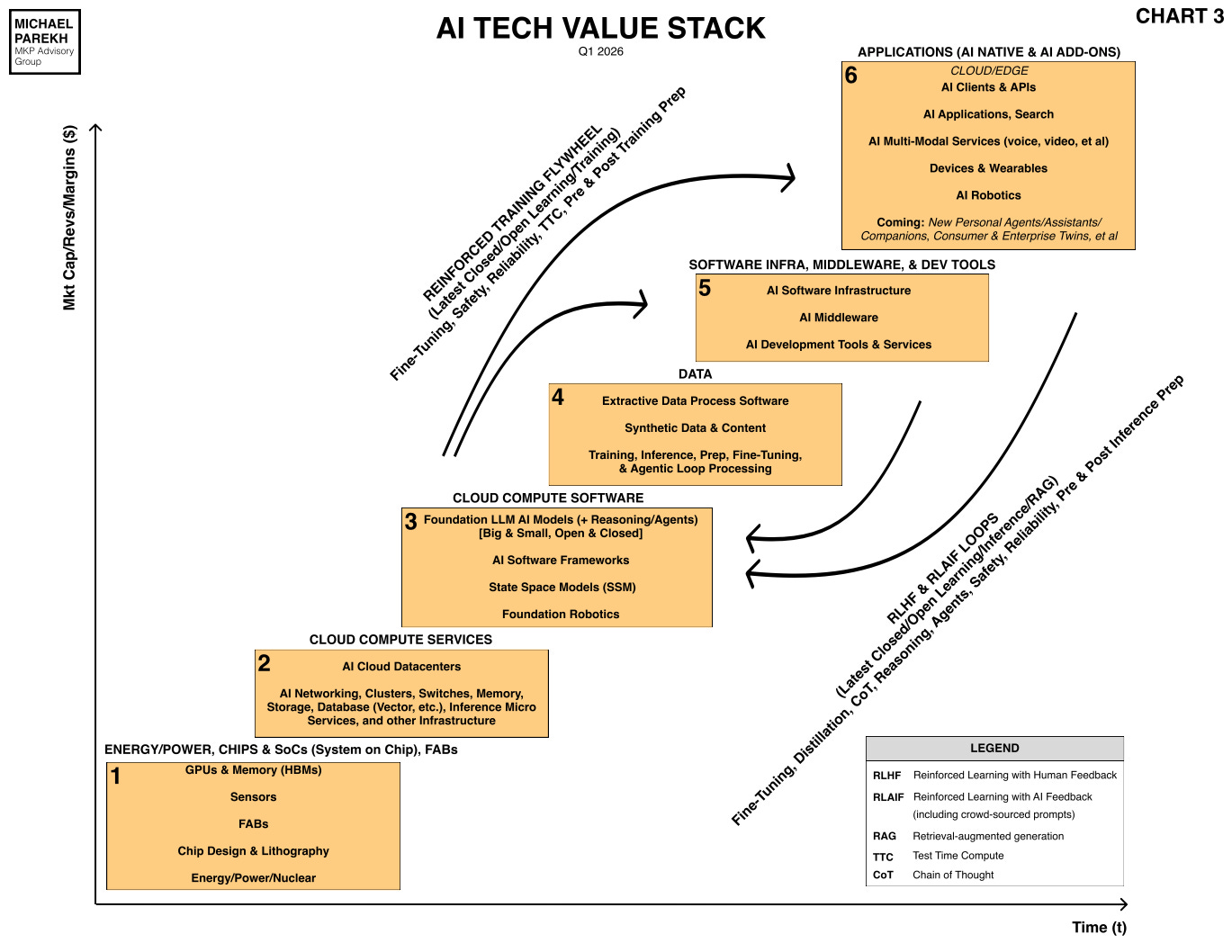
There will of course be other winners, incumbents and AI Startups. But the opportunity for Google to win as well is strong, in this ‘Mainframe’ stage of the AI Tech Wave.
That is a Bigger Picture to keep in mind, as we wait for the three trillion dollar mega-AI IPO companies also do their AI thing this year and beyond. Stay tuned.
(NOTE: The discussions here are for information purposes only, and not meant as investment advice at any time. Thanks for joining us here)


