Is the CapEx Sustainable?; Google Breakdown

Here’s a preview of what we’ll cover this week:
Macro: Bread and Synchrony Confirmed Consumer Strength
Markets: High Expectations; When Will Semiconductors Bottom?; We Are In A Rotation; The Bull Market Remains Intact; Plenty of Worry. Plenty of Cash; Google Gets the Microsoft Treatment; The AI CapEx Boom Has a Counterparty Problem; Oracle = OpenAI; The Big Picture on AI Adoption; Financial Services Are The Real AI Beneficiaries
Lumida Curations: Jon Gray On Jevons Paradox And AI; Jamie Dimon On AI’s Real Challenge; Matthew Smith On Energy and AI
Grateful For Your Trust In Lumida

We completed our community round last week, having raised approximately $600,000.
This was the largest raised in June 2026 with the highest per capita contribution, and we only marketed it to our closer community following this newsletter.
We are still waiting to get access to the email addresses for those that got involved. When we do we will start sending regular community updates.
In August, we are pushing major releases to the app. I expect that by Q4 that only real feature gap missing will be enabling investing / trading against these pre-built strategies.
It’s truly a special app and I recommend people give it a look at www.lumidainvest.com.
The opportunity for AI to transform investing is just too massive to ignore. Old guard names like Robinhood simply can’t adapt their form factor without compromising their economics.
We are contemplating a large venture round in the fall to get after this opportunity based on our traction. Shoot me a note if you’re interested in exploring.
Macro
Bread and Synchrony Confirmed Consumer Strength
Over the last several issues, we’ve seen a steady stream of data supporting a resilient US consumer.
This week, two more witnesses took the stand.
Synchrony and Bread Financial both reported Q2 earnings. Headline earnings came in strong, beating analysts’ estimates by high double digits.
Their transcripts offer valuable insights on how consumer strength has shaped over the last year, and where it’s headed.
Synchrony’s CEO Brian Doubles delivered the headline: “demand remains strong.” And it’s holding despite the things that are supposed to break it.
Brian highlighted particular strengths in entertainment, retail, and electronics. (That sounds a lot like my trip to Best Buy with my sons a few months ago. Watch the livestream here.)
It’s easy to lend out money, but you can get the money back? That’s why credit quality.
Brian also highlighted the driver of this outperformance: “resilient consumer behavior [is] likely supported by some benefit from increased tax refunds and lower tax withholdings.”

We see the same consumer strength in this week’s retail sales data.
Retail sales grew 8.0% y/y in the week ending July 17, even after the World Cup bump faded, significantly above last year’s levels.
Bread Financial also told the same story on consumers, but from the other side of the credit spectrum.
CEO Ralph Andretta: “Our consumers’ financial health remains resilient, as evidenced by continued sales growth, a stable re-payment rate, and improving credit performance.”
CFO Perry Beberman credited the backdrop directly: “The tailwind of tax season, along with generally healthy employment and wage growth, helped blunt inflationary pressure, resulting in strong sales and payments.”
Fun fact: I used to work with both Ralph and Perry when we were at Bank of America shortly after the financial crisis. They are capable executives. We own their stock as well.
Bread saw improvement in both its net loss rate and delinquency rate. Its reserve rate improved 66 basis points YoY.
When looking at consumer lenders, you need to ensure credit performance is working.
Synchrony’s picture was just as healthy.
Synchrony’s CFO noted that delinquency “entry rates are still as strong as or better than 2019,” with delinquency “stable to improving” and “really solid credit trends” across the book.
Repayment behavior is holding up too, with Synchrony’s payment rate running well above its pre-pandemic average. Consumers are paying their bills.
A major driver of this consumer strength is the labor market.

This week’s weekly jobless claims confirmed the labor market remains in good shape.
Wages are growing, and employment is healthy.
Reports of death by AI apocalypse appear greatly exaggerated.
Strong consumers are the foundation of a resilient demand, which drives businesses, earnings and markets.
Overall, the economic engine continues to hum.
Markets
High Expectations
Markets closed its second consecutive week in red, last seen during the Strait of Hormuz conflict.

The S&P 500 fell 0.6%, the Russell 2000 declined 1.1%, and the Nasdaq 100 dropped 1.6%.
Now, the Nasdaq increasingly owns some pricey IPOs like SpaceX… that’s not great for the venerable QQQs.
It’s quite possible that the QQQs have emerged as the new index funding short, as opposed to the IWM small cap index that has seen tremendous YTD performance.

The oversold conditions of SMH had attracted some dip buying, but this bounce does not change the broader story of a post-meltup hangover effect.
As we’ve noted a number of time, the current market regime for semis resembles the summer of 2024 after Nvidia re-rated. It took several months for the category to reset after elevated positioning.
That’s very likely the case here too.
We flagged this back on Jun 21st when ETF volumes on SMH peaked, and after every peak, the index correct. That’s the phase we’re in now. Read the newsletter here.

When people regret buying semis at the top and the narrative is sour, you want to pick up semis again.

Earnings Are Strong
In the initial weeks of the earnings season, Over 78% of companies delivered double beats (beating both revenues and earnings estimates), while over 88% of the companies have beaten earnings estimates.
This is significantly higher from previous averages.

This is the crucial variable — the economy is fine. And, this is not a stimulus driven sugar high like we saw in Q4 2021.
We have had solid to strong earnings reports coming from TSMC, ASML, Intel, Alphabet, Texas Instruments, and others.
But, all of them were met with weak or negative reactions.
That tells you one thing:
Everyone crowded into semis following the momentum.
Weak handed recent buyers need to flush out to setup the next advance.
Alphabet reported 83% cloud growth and announced another major increase in capital expenditures.
Alphabet confirming it was not a surprise. The market had already priced it in.
It is worth revisiting the analyst’s price target chart we shared in June.
(We flagged this chart in our 21st May newsletter, where we discussed the first signs of a semis top, and a forthcoming rotation that we saw this month.)

At the time, semis were the only industry group trading above the average analyst price targets, while nearly every other industry remained below.
This was the proof that semis stocks had out-run even expectations.
When Will Semiconductors Bottom?
Investors have an urge to call the bottom in semiconductors after every bounce.
It is probably too early.
According to BoFA’s fund-manager survey, 82% of respondents now identify “long global semiconductors” as the world’s most crowded trade. Nothing else is close.
And, what happens to crowded trade when they become consensus (aka no one left to buy)?
They unwind.

Crowded trades do not bottom simply because valuations have become cheaper.
They bottom when positioning has reset.
That can take longer than expected because the same investors who bought the sector on the way up must gradually reduce exposure on the way down.
Fund managers are already doing it. The BoFA FMS shows fund managers have reduced their tech exposure by 8% to 18% in July (second consecutive monthly outflow).
And, despite the cut, their weight on technology stays higher than its last top in Dec’25.

Some memory companies, including Micron and SK Hynix, may eventually find support from lower valuations and stronger cash generation.
But, other semiconductor names were owned primarily because they had momentum.
And, now, they have lost it.
Look at Vertiv Holdings for example.
Back in May, we flagged Vertiv is a cooling business with interest of a memory stock.
The stock reached a peak forward P/E of 54.3x around the same time.
It turns out the week we wrote about Vertiv was the top in the stock also.

The stock has dipped about 28% from its peak.
We Are In A Rotation
The largest winners from April and May have been selling off, while several of the market’s weaker and less crowded sectors have begun to recover.
Technology gained ~44% during April and May. The Nasdaq 100 rose ~28%.
But, things have changed now.
Since the beginning of June, technology has fallen 6.6%, while the Nasdaq 100 has declined 6.3%.
At the same time:
Financials are up 8.2%.
Healthcare has gained 8.0%.
Energy is up 5.5%.
Utilities have advanced 4.0%.

This is exactly what rotation looks like.
The hottest areas of the market are taking a timeout while capital moves toward sectors that had been left behind.
The market is beginning to demand better valuations, cleaner earnings and less crowded positioning.
This is the broadening we expected to see, and it should continue on the back of a stong economy.
And… we still haven’t seen the AI beneficiary theme take root.
Watch Earnings In Real Time
Despite poor reactions, the underlying earnings season has been strong.
We have created an earnings monitor in the Lumida Invest app.
It provides quick earnings highlights for each company.
Our AI also analyzes the complete transcript for fundamental and thematic insights, and you can read them on the stock page. Download the app here to test for yourself.
Scanning the Earnings news give you a deeper perpsective into the economy, and flags opportunities.

Better earnings and weaker reactions mean one-thing: more reasonable valuations.
The S&P 500’s PEG ratio (the index’s P/E valuation relative to expected earnings growth) has fallen to approximately 0.8.

A PEG ratio below 1 means valuations have not kept pace with expected earnings growth.
The main reason why the PEG ratio is low is that rise in capex.
The bear case is that depreciation is making earnings look pretty by spreading out in-year capital expenditures.
Below is a chart of the S&P free cashflow yield. You can see the FCF yields have come in substantially since the Oct 2022 bottom owning equities was a no-brainer.
The entire case for cloud is whether or not the capex is productive and NPV positive. In the case of Google and Microsoft, we believe the answer is ‘yes’.

Plenty of Worry. Plenty of Cash.
Investor confidence has already fallen sharply.
AAII bullish sentiment dropped to 29.6% this week, a decline of 15.3 percentage points. It was one of the larger weekly drops recorded over the past four decades.
(We have added a sentiment tracker to market color page on the Lumida Invest app. It processes data from multiple investor surveys to gauge investors’ confidence. Download the app here.)

Retail buying, another indicator of sentiment, is at pandemic lows.

Investors are cautious, and they aren’t trusting the market. That flush in sentiment is healthy.
That said, Financial Advisors were euphoric just a few weeks ago.
We highlighted this and it continually seems to do a good job at flagging periods where momentum starts to unwind.

The above sentiment score is the fly in the ointment – particularly for crowded categories like semis.
It only needs some of the investors currently sitting in cash to become less bearish.
Growth stocks have corrected quite a bit. But, don’t think we’re out of the woods yet.

However, notice the earnings estimates for growth stocks. Those are cloud stocks and semis. You can see the script unfold of strong earnings reports rolling out in October.
If we see a continued correction in technology stocks and semis going into October, those names should likely be bought.

Read our newsletter on quality rotation to see where we are betting.
Google Earnings Breakdown
Google stock fell 7% after earnings, its only meaningful negative earnings reaction since 2025.
We shifted back to an overweight on Google the morning of earnings. Buying high quality dislocated assets is a reasonable strategy.


The quarterly numbers were excellent.
Alphabet revenue grew 24% to $119.8 billion.
Operating income increased 30% to $40.8 billion, with margins expanding to 34%.
The Gemini app reached 950 million monthly active users.
That’s a big deal. Google Gemini is eating into OpenAI and Claude.
Our engineers our running out of Claude token limits, and shifting to Google which also has the large context window. We see the shift first hand.
AI Mode has now crossed 1 billion monthly users and, importantly, Google says it is increasing overall search activity rather than replacing traditional queries
Cloud revenue grew 82%. Management remarked “core Google Cloud Platform, AI infrastructure and AI solutions” all contributed.
Sundar says Google is acquiring new cloud customers at more than twice last year’s pace.
If you were thinking what caused the 10% drawdown despite everything green, here comes the difficult part.
CapEx
Google spent $44.9 billion on capital expenditures during the quarter, with 60% going into servers and the rest into data centers and networking equipment.
That was more than the $39 billion generated from operating cash flows, pushing quarterly free cash flow to negative $5.9 billion.
(Before Q2, analysts were expecting Meta to have the worst FCF decline in the S&P 500 at 97% YoY. Guess Google didn’t want Meta to have that trophy.)
Google also raised its 2026 CapEx outlook to between $195 billion and $205 billion, up from its previous range of $180 billion to $190 billion.
Management expects spending to rise significantly again in 2027.
This is enormous spending, even for Google.
How does management justify it?
Sundar says demand is arriving faster than the company can build capacity. Backlog has reached $514 billion with 50% of it to be realized in the next two years.
Management also said it is working under a “disciplined ROIC framework,” with the return profile on future investments looking healthier than it did a year ago.
My view on Google is that we are indeed seen strong returns to capex spending.
Yes, the Free Cashflow after Capex is flat. Google is pouring money into datacenters and TPU.
But, they are factually seeing a return on capex. Break it out by vintage. Look at the strong growth in not just revenue but cash inflows. That strong cash inflow today is the result of capex last year.


If you’re an owner of Google stock, you’d want this capex to continue – especially if you believe we are early in the AI adoption cycle (as we do).
Further, Google’s ROIC is at 24%. Ruth Porat and their CFO team are outstanding. Their capital allocation has a sound track record.

Next year at this time, Google’s cloud business will be bigger than Microsoft and Amazon at this rate. That’s an incredible story. Google was always a distant #3 – now they are moving to leadership status.
Also, Google has more efficient margins with their TPU chip built by Broadcom. The read thru to Broadcom is positive as well.
What about other growth levers?
Gemini Is Already Inside the Enterprise
The market spends too much time debating whether Gemini is number one or number two on the latest AI benchmark.
Google is playing a broader game.
Sundar put it well when discussing the company’s competitive advantage:
“The model is just an ingredient in [our cloud] solutions.”
That is the right way to think about Google’s AI business.
Large companies do not simply want access to a chatbot. They want AI connected to their internal data, secured properly, governed centrally and integrated into existing workflows.
Google can provide the entire stack: chips, models, cloud infrastructure, cybersecurity, data analytics, agents and distribution.
Gemini Enterprise is used by nearly 90% of the Fortune 100. (Is that trial or deep engagement, probably more of the former, but still.)
The adoption is also showing up in actual usage.
Nearly 500 Cloud customers have each processed more than 1 trillion tokens over the past year.
Google’s strategy also differs from the frontier labs.
OpenAI and Anthropic are competing aggressively to own the best model at the frontier.
Google wants to compete there too (Gemini 4 is already in training), but it is also shipping cheaper models designed for everyday enterprise workloads.
Sundar called Gemini Flash the company’s “workhorse model” because it hits the “Sweet spot of performance, cost, reliability, latency.”
That may be the more important market.
Most companies do not need the most intelligent and expensive model for every task.
They need one that is fast, reliable, secure and cheap enough to run thousands of times per day.
Google learned this lesson from the browser wars.
Internet Explorer did not need to be the best browser. It was good enough, bundled with Windows and had distribution.
Gemini increasingly has the same advantage across Search, Workspace, Android and Google Cloud.
Google does not need to win every benchmark.
It needs to make Gemini good enough and put it everywhere.
After the post-earnings sell-off, I’m once again quite interested in Google. We had trimmed quite a bit of our Google exposure back in November thru January of this past year after we concluded it was fully valued.
On a trailing PE basis, Google has never been cheaper.

We have a modest overweight on Google (1 to 2%). If Google were to drop another 5%, we think that would offer compelling value and we’d increase our position.
Here is Google vs analyst price targets. Usually at these levels you see good forward returns.

The risk is that OpenAI and Anthropic continue raising enough capital to fund more infrastructure, strengthen their enterprise products and prevent Google from absorbing the demand they cannot serve.
But, from our base case, Google remains in the best position among the global consumer AI firms.
The AI CapEx Boom Has a Counterparty Problem
Google’s backlog of $614 billion is strong.
Where else do you see the same scale of backlog?
Oracle, Microsoft, and Amazon.
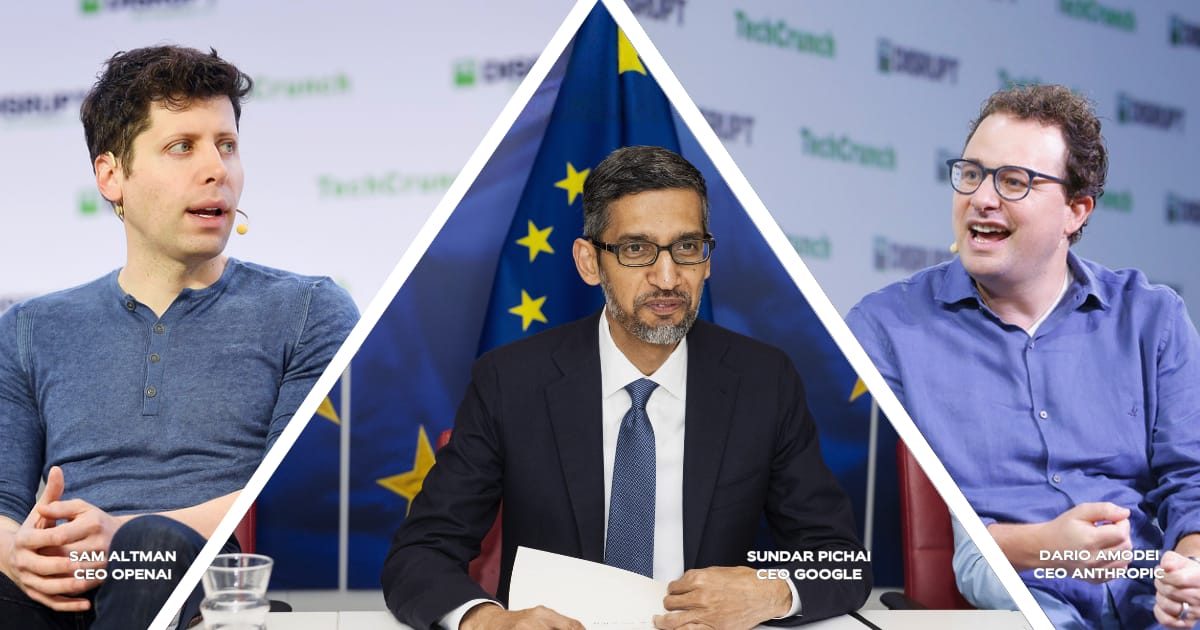
But, there is a a caveat, and it features Sam Altman, and his former head of research, Dario Amodei.
As per The Information, OpenAI and Anthropic account for roughly half of the hyperscalers’ combined revenue backlog.
This is the bear case. The capex spend to unlock that revenue backlog may not have a customer that can pay the bills.

Microsoft’s $600B+ backlog includes an estimated $280 billion of spending commitments from OpenAI. Oracle has another $300 billion tied to OpenAI.
Google has around $200 billion linked to Anthropic, while Amazon has exposure to both labs.
So, if you think about it, hyperscalers’ cash ouflow today is for future demand from a LLM provider, who in Charlie Scharf’s words, might not even be there in 15 years.
OpenAI and Anthropic are not Microsoft or Google.
They do not have mature, highly profitable businesses generating enough cash to fund these obligations internally.
Their ability to honor the commitments depends on continuously raising more equity, debt and strategic capital.
We were one of the first to flag this connection back in November. I have an FSD called ‘Sam Altman Broke the World’.
That creates a basic question:
What happens to the backlog if one of them cannot keep funding the buildout?
A $300 billion OpenAI commitment is not an airline seat that Oracle can simply resell.
The capacity may eventually find another user.
That is the counterparty risk.
Overall, however, we believe the datacenter contracts can be re-assigned and internally consumed by the hyperscalars themselves.
The productivity gains from AI are too strong, and that creates its own demand.
Just take a look at the US government taking out a contract with Oracle. We are just seeing the beginning of Dept of War spending on AI.

We held our nose and picked up a starter position in Oracle this past week.
The Big Picture on AI Adoption
Our view is that AI adoption rates remain low, and will continue to increase.
Tools like Claude Cowork and OpenAI Codex have strong PMF and commercial value – far more so than the AI chatbot.
We are going to see myriad, capable ‘fast follow’ offerings from Microsoft, Google, Meta and perhaps others.
The net result?
Demand for cloud and demand for inference will continue to outstrip supply.
The edge Google and Microsoft have over Claude Cowork is simple.
The UX will be better.
Example: Claude Cowork’s experience taking control of the browser to edit a Google doc is slow and clumsy as compared to talking to Google Gemini.
Native access to the OS and to the web app creates a UX advantage.
The cloud giants also have more compute and therefore faster response, which we know is a big driver of user satisfaction.
Financial Services Are The Real AI Beneficiaries
The first phase of AI trade rewarded the companies building the models and supplying the chips.
The next phase should reward the businesses that use AI to remove costs, increase employee productivity, and improve the customer experience.
Financial services sit near the top of that list.
This week, Manulife (MFC) expanded its partnership with Microsoft under a new five-year agreement.
Microsoft 365 Copilot will be deployed to more than 30,000 employees, while Azure and Microsoft Foundry will support the development of AI applications across the company.
Manulife is using AI to give financial advisors personalized sales insights, automate the initial assessment of life-insurance applications, and support more than 110 million customer calls each year.
The company says it had generated $300 million of enterprise value from AI by the end of 2025 and expects that figure to exceed $1 billion by 2027.
That is what makes AI-story interesting.
Banks and insurers have expensive employees, repetitive processes, enormous proprietary datasets, and millions of customer interactions.
Even a small improvement in underwriting, fraud detection, compliance, servicing, or advisor productivity can produce hundreds of millions of dollars in value.
And the returns are easy to measure.
Did the advisor sell more products?
Did the underwriter process more applications?
Did the call center resolve issues faster?
Did fraud losses fall?
AI can take financial services on a whole new level. Advisors can receive real-time prompts before speaking with clients. Underwriting that currently takes weeks will happen in minutes.
AI agents will move money, rebalance portfolios, handle routine servicing, and coordinate with accountants, attorneys, and advisors.
The winners in finance services will be companies using AI to make their services faster, cheaper, and more personal.
My guess is that a financial institution that does not yet exist will turn this opportunity into a $50 billion company over the next decade.
This MFC-MSFT contract also highlights the AI growth lever for Microsoft that the market seems to have forgotten about.
The stock’s trading at P/E NTM of ~20x – the last time it traded at these levels was back in 2017, when Microsoft 365 was its only revenue driver.

Bill Ackman has also followed us into the name. He has now followed us three times on our non-consensus bets: Google (last year), Meta, and now, Microsoft. The latter two played out well. We’ll see how this one does.
No need to thank us, Bill!

Lumida Curations
Jon Gray: Why Jevons Paradox Matters for AI
Blackstone President Jon Gray explains why falling AI costs could increase demand for compute, data centers, energy, and physical infrastructure.

Jamie Dimon: AI’s Real Challenge Is the Skills Gap
JPMorgan CEO Jamie Dimon argues that AI-driven job displacement is manageable, but only if governments and businesses invest early in retraining workers for the roles being created.

Matthew Smith: Every AI Headline Is Really an Energy Headline
Matthew Smith explains why AI’s expansion ultimately depends on natural gas, grid capacity, and whether new data centers can secure reliable power fast enough.

Meme
@lumidamemes Tesla’s revenue grew 26%, but operating income fell 57% and the stock dropped 14.5% after earnings.
For more memes, follow Lumida Memes

Not Subscribed Yet? Don’t miss out on future insights—subscribe to the newsletter now!
For real-time updates, follow us on:
X | Telegram | Youtube | TikTok | News | Ram’s X | Lumida Health | Lumida Tax | Lumida Memes
As Featured In


Disclaimer: Lumida Wealth Management LLC (‘Lumida”) is located in New York, NY, and is an SEC registered investment adviser. SEC registration does not constitute an endorsement of the firm by the Commission nor does it indicate that the adviser has attained a particular level of skill or ability. Lumida only transact business in those states in which it is registered, or qualifies for an exemption or exclusion from registration requirements. Any direct communication by Lumida with a prospective client will be conducted by a representative that is either registered or qualifies for an exemption or exclusion from registration in the state where the prospective client resides.
The information in this material has been obtained from sources believed to be reliable. While all reasonable care has been taken to ensure that the facts stated in this material are accurate and that the forecasts, opinions and expectations contained herein are fair and reasonable, Lumida, Inc. and Lumida Wealth Management LLC (collectively Lumida) make no representations or warranties whatsoever the completeness or accuracy of the material provided, except with respect to any disclosures relative to Lumida. Accordingly, no reliance should be placed on the accuracy, fairness or completeness of the information contained in this material. Any data discrepancies in this material could be the result of different calculations and/or adjustments. Lumida accepts no liability whatsoever for any loss arising from any use of this material or its contents, and neither Lumida nor any of its respective directors, officers or employees, shall be in any way responsible for the contents hereof, apart from the liabilities and responsibilities that may be imposed on them by the relevant regulatory authority in the jurisdiction in question, or the regulatory regime thereunder. Opinions,forecasts or projections contained in this material represent Lumida’s current opinions or judgment as of the day of the material only and are therefore subject to change without notice. Periodic updates may be provided on companies/industries based on company-specific developments or announcements, market conditions or any other publicly available information. There can be no assurance that future results or events will be consistent with any such opinions, forecasts or projections, which represent only one possible outcome. Furthermore, such opinions, forecasts or projections are subject to certain risks, uncertainties and assumptions that have not been verified, and future actual results or events could differ materially. The value of, or income from, any investments referred to in this material may fluctuate and/or be affected by changes in exchange rates. All pricing is indicative as of the close of market for the securities discussed, unless otherwise stated. Past performance is not indicative of future results. Accordingly, investors may receive back less than originally invested. This material is not intended as an offer or solicitation for the purchase or sale of any financial instrument. The opinions and recommendations herein do not take into account individual client circumstances, objectives, or needs and are not intended as recommendations of particular securities, financial instruments or strategies to particular clients. The recipients of this material must make their own independent decisions regarding any securities or financial instruments mentioned herein and should seek advice from such independent financial, legal, tax or other adviser as they deem necessary. Lumida may trade as a principal on the basis of its views and research, and it may also engage in transactions for its own account or for its clients’ accounts in a manner inconsistent with the views taken in this material, and Lumida is under no obligation to ensure that such other communication is brought to the attention of any recipient of this material. Others within Lumida may take views that are inconsistent with those taken in this material. Employees of Lumida not involved in the preparation of this material may have investments in the financial instruments or securities (or derivatives of such financial instruments or securities) mentioned in this material and may trade them in ways different from those discussed in this material. This material is not an advertisement for or marketing of any issuer, its products or services, or its securities in any jurisdiction.