“AI Capital expenditures are slated to use up all of Amazon’s cash flow from operations this year and most of that at Google and Meta.”
“Amazon, Google, Meta face free cash flow wipeout from AI capex.”
“Companies must choose between stock buybacks or increased borrowing.”
“Oracle already leveraged for its AI data center expansion.”
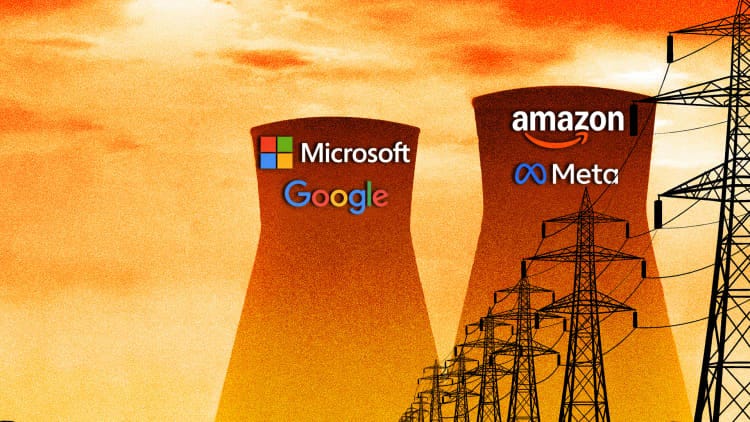
“Big tech’s dramatic ramp-up in projected capital expenditures this year will all but wipe out free cash flow for Amazon, Google and Meta Platforms. That will force some of those companies to make some difficult choices, such as whether to end stock buybacks or borrow more money.”
“The good news is that the big tech companies have the capacity to each borrow hundreds of billions more money than they currently do.”
“Most of the big tech companies in recent years have begun returning cash to shareholders through dividends and buying back stock. Google and Meta Platforms, for instance, do both. But that could be difficult this year, with capital expenditures aimed at expanding computing capacity for AI almost entirely absorbing the cash their operations generate.”
“Google and Meta have already started to scale back their stock buybacks. Cutting off the dividend, though, could be tricky, as both companies only introduced the payouts in 2024, which made their stocks more appealing to investors.”
“Amazon won’t have the same problem, as it hasn’t bought back stock since 2022 and has never paid a dividend. But its projected capex this year of $200 billion is higher than the $178 billion in cash from operations analysts estimate it will produce, according to S&P Global Market Intelligence, which means unlike the other companies it will burn cash anyway.”
“Amazon issued $15 billion in bonds in November, beefing up its cash position, so it had $123 billion in cash on hand as of Dec. 31. That gives it a sizable cushion. Still, it is in talks to invest tens of billions in OpenAI, The Information has reported, which will reduce that cash pile meaningfully. On Friday, Amazon signaled its intention to borrow more money, filing a registration statement with the Securities and Exchange Commission that gives it the ability to quickly sell bonds.”
“Deal comes as Google parent steps up AI borrowing rush with $20bn sale of dollar bonds.”
”Alphabet has lined up banks to sell a rare 100-year bond, stepping up a borrowing spree by Big Tech companies racing to fund their vast investments in artificial intelligence this year.”
“The so-called century bond will form part of a debut sterling issuance this week by Google’s parent company, according to people familiar with the matter. Alphabet was also selling $20bn of dollar bonds on Monday and lining up a Swiss franc bond sale, the people said. The dollar portion of the deal was upsized from $15bn because of strong demand, they added.”
“Century bonds — long-term borrowing at its most extreme — are highly unusual, although a flurry was sold during the period of very low interest rates that followed the financial crisis, including by governments such as Austria and Argentina. The University of Oxford, EDF and the Wellcome Trust — the most recent in 2018 — are the only issuers to have previously tapped the sterling century market.”
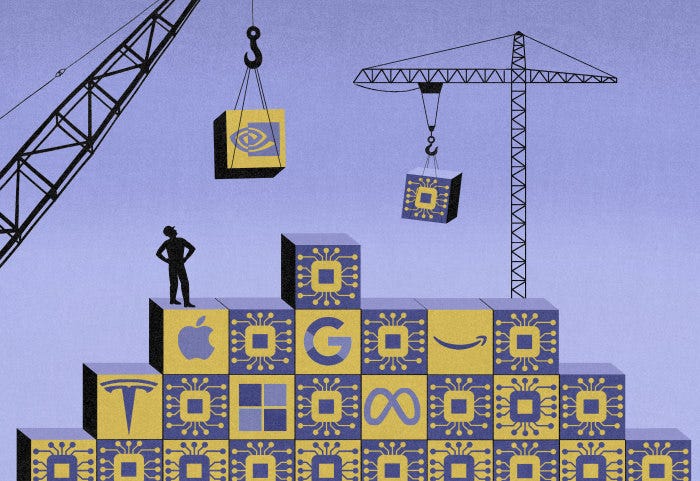
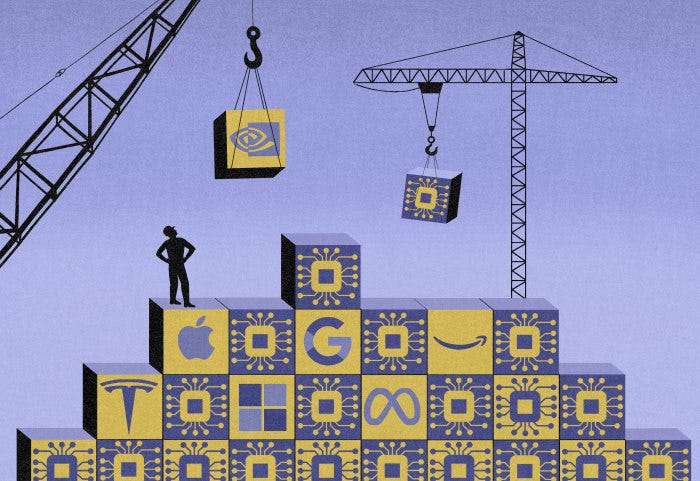
“Such sales are even rarer in the tech sector, with most of the industry’s biggest groups issuing up to 40 years, although IBM sold a 100-year bond back in 1996. Big Tech companies and their suppliers are expected to invest almost $700bn in AI infrastructure this year and are increasingly turning to the debt markets to finance the giant data centre build-out.”
“Microsoft is in a different position. Its capex ramp-up hasn’t been quite as aggressive as the other companies’. In the first half of its 2026 June-ending fiscal year, for instance, it has spent $49 billion on capex, easily covered by the $80 billion in cash generated by its operations. For the full year ending in June, analysts are projecting $103 billion in capex, leaving it with free cash flow of $66 billion, only down a little from fiscal 2025, according to S&P Global Market Intelligence. (Microsoft has said its fiscal year 2026 growth rate in capex in fiscal 2026 will be greater than it was last year, when capex grew 45% to $65 billion, but it hasn’t projected a full-year number, unlike the other companies.)”
“While Microsoft will likely generate plenty of free cash flow, it faces constraints the other companies don’t have—namely, a much bigger dividend commitment. Microsoft paid out $24 billion in dividends last fiscal year and has raised the dividend 10% this year.”
“In comparison, Meta and Google paid out $5 billion and $10 billion in dividends, respectively. They should still be able to afford those payments this year, although it will be tight for Meta in particular. The Facebook owner also spent $26 billion on stock buybacks last year, a slight drop from 2024, but with its free cash flow likely to shrivel this year it seems likely to have to slash its buyback this year.”
“Like Amazon, Meta and Google both sold debt last year, buttressing their cash resources. All three of the companies have ample borrowing capacity left. Take Google: credit ratings agency S&P said in November the company could lift its “net debt over $200 billion” before it would trigger a downgrade in its bluechip AA+ credit rating. Google currently has $47 billion of debt, which is more than offset by its $127 billion in cash, which means it has no net debt.”
“Analysts estimate Google will generate $218 billion in earnings before interest, taxes, depreciation and amortization in 2026, according to S&P. In theory, if it was willing to accept a lower credit rating, it could borrow twice its projected Ebitda, which would be $400 billion.”
Companies like Oracle, an important OpenAI infrastructure partner, that doesn’t have the balance sheet of its larger peers, is another notable example.
“One company that has already stretched its balance sheet to pay for expanded AI computing capacity investment is Oracle. It had about $88 billion in net debt as of Nov. 30, more than twice its estimated fiscal 2026 Ebitda of $35.5 billion. Oracle is raising between $45 billion and $50 billion in debt and equity to help finance its data center build-out.”
“Oracle also is on track to pay out $5.7 billion in dividends this year, even though it is burning cash. Investors, however, have responded negatively: Oracle stock has dropped 27% so far this year.”
The whole piece is worth a closer read, especially for the accompanying charts and numbers.
But the broader takeaway is clear.
What started as ‘relatively easy’ spending by massive cash generating big tech companies like Google, Meta, Microsoft, Amazon and others, is increasingly reaching its limit vs the pure cash from core businesses.
Now the companies and investors have to grapple with accelerated spending that stretches their financials in various ways.
So the debate over this spending will get louder, as the spending accelerates beyond the $6-700 billion plus planned for this year alone by the big tech companies. Stay tuned.
(NOTE: The discussions here are for information purposes only, and not meant as investment advice at any time. Thanks for joining us here)
Crypto Four financial topics that are likely to come up at the Thanksgiving Day table, including Bitcoin. (optimisticallie.com) Mainstream financial firms...