It’s Christmas Day, December 25, 2025. And billions around the worlld are celebrating close time with their loved ones near and far.
On this day of closer contemplation of a year almost done, and a week away from celebrating the New Year, I thought it’d be useful to think about the extraordinary AI Tech Wave to date against some other extraordinary human achievements.
OpenAI alone has AI Data Center and Power Infrastructure deals worth over $1.4 trillion. And other US big tech companies, the Mag 7s with cumulative collective market caps of over $21.5 trillion, have the resources to get us at least some of the way to the shiny, yet daunting AI goals of this AI Tech Wave ahead.
An extraordinary statement of confidence in an aspirational objective. Utterly dependent on combining barely researched space technologies, and their applications at the same time. Much like AGI and the almost surreal aspirations around those AI goals today.
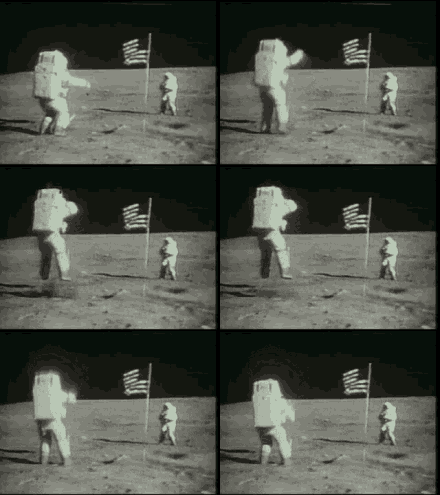
The moon landing was a tangible goal viewed by countless millions. And one that united the world briefly, even though the catalyst was nation to nation, geopolitical competition. Driven by the fear of missing out (FOMO).
Benefiting of course Nvidia and scores of other US technology companies large and small.
Pulling further on the NASA example, it propelled NASA to send another ten astronauts to the moon until 1972. That’s when the geopolitically driven ‘space race’ enthusiasm petered out.
And left NASA free to dozens of other exploratory missions per year, amounting to thousands of missions large and small that advanced US Science and Technology. And of course benefited the world with satellites, GPS, smartphone components, microwave appliances, and of course velcro. Amongst countless other benefits.
In fact the subsequent PC, Internet, and Mobile tech waves along owed huge gratitude to the technology innovations catalysec by the space race, and allowed those waves to deliver technologies we’re still benefiting from around the world. Think about it every time you use Google and/or call an Uber.
I ran some numbers to run the NASA tab to date. And the general numbers point to a national investment of over $2 trillion in NASA from 1958 to today. In today’s dollars. Here’s what I asked Perplexity:
“When was NASA created and how much money has been invested in 2025 dollars since then in NASA totally. Include all missions.”
“NASA was created in 1958 and began operations on October 1, 1958, following the National Aeronautics and Space Act signed on July 29, 1958. In aggregate, the United States has spent a little over roughly 1.8 trillion 2024‑dollars on NASA, which corresponds to on the order of about 1.8–2.0 trillion in 2025‑dollars when rounded, covering all programs and missions since inception.”
I followed up with this prompt:
“What is that per year in 2025 dollars? And how many missions were done in total and per year over that time?”
This was the reply:
“From 1958 through the mid‑2020s, NASA’s total budget works out to on the order of about 25–30 billion 2025‑dollars per year on average, once everything is inflation‑adjusted and averaged over the whole period. This is an approximate figure, but it is consistent with (1) a total lifetime spend a bit under 2 trillion inflation‑adjusted dollars and (2) current annual budgets in the mid‑20‑billions range.”
“There is no single authoritative count of “all NASA missions” across all programs, but available catalogs indicate NASA has flown on the order of a few thousand missions of various sizes since 1958, which averages to dozens per year depending on how “mission” is defined. Any precise number would depend heavily on whether you count only major spaceflight missions, or also include sounding rockets, aircraft campaigns, suborbital tests, tech demos, and other small projects.”
I show you the above back and forth because it’s a vivid example of the current benefits of this AI technology, despite its current faults and inadequacies. Yes, the same AIs used by over a billion people using OpenAI ChatGPT, Google Gemini and other LLM AIs every day.
That I could get these rough approximations across mountains of data, with their source links, in a few minutes of Christmas morning pondering is worth celebrating. As a life-time analyst, these LLM AI tools never get old. And they’re only going to get better.
And much like the NASA Gemini, and Apollo missions to come, they yielded exponentially valuable results from the beginning.
A two trillion dollar total expenditure on NASA from 1958 to 2025, across 67 years, also shows a relative comparison to the trillions that are planned to be invested in AI over just half a decade ahead of this AI Tech Wave. Less than 2% of the global 2025 GDP numbers. And an even smaller fraction of the quadrillion US GDP numbers over 67 years from 1958 to 2025 in today’s dollars.
In a world with annual GDP of over $125+ trillion, one can see how its reasonable to expect some net good results from all this AI effort. Especially given ‘moonshot’ expenditures of the past.
And that is something celebrating as well this Christmas Day of 2025.
Welcome back to the Lumida Ledger. If you find this valuable, we’d greatly appreciate you sharing it far & wide with your network. That’s how we grow...
Crypto You can buy Bitcoin, Strategy ($MSTR) or this thing. (sherwood.news) Buy a lot of $TRUMP, get invited to meet the President. (cnbc.com) Apple The...
Newsletters Make sure you stay on top of everything on Abnormal Returns. Sign up for our (free) daily e-mail newsletter. (abnormalreturns.com) Are you...