As a country with a population slightly bigger than China 1.4 billion, but with far better demographics, India has an edge. It remains the forever attractive partner for foreign direct investments (FDI) by companies US and beyond.
Yet, given India’s historic ‘self-sufficiency’ DNA, and ‘British Raj’ driven regulatory insularity, has had India on a markedly different development pace than China. Especially in infrastructure starved manufacturing. It’s now being addressed by the Modi government.
But the lag of course shows in the relative economies. Over $20+ trillion in GDP for China vs $4+ trillion for India. The US of course leads the world with over $30 trillion in a $120+ trillion global economy. With AI still poised for a 7% boost on global GDP by the end of the decade by folks at Goldman Sachs.
And AI has now been the perceived driver for acclerated economic growth both for the world, and rapidly developing countries like China and India.
And while China is already the number two globally in AI, with a clearer runway to #1. Especially when one considers its unrivaled manufacturing ecosystems in cars, robotics, solar, power generation, rare earth refining and so much more. As well as its unrivaled trained STEM graduate output relative to global counterparts.
But India still has an opportunity, to be rapidly growing contender by 2050.
Indeed, Prime Minister Modi has officially planted a flag for India to be a developed country by 2047, a timeline as equidistant from today, as the mid-nineties were, when the Internet first got going as a commercial, global tech wave in the first place.
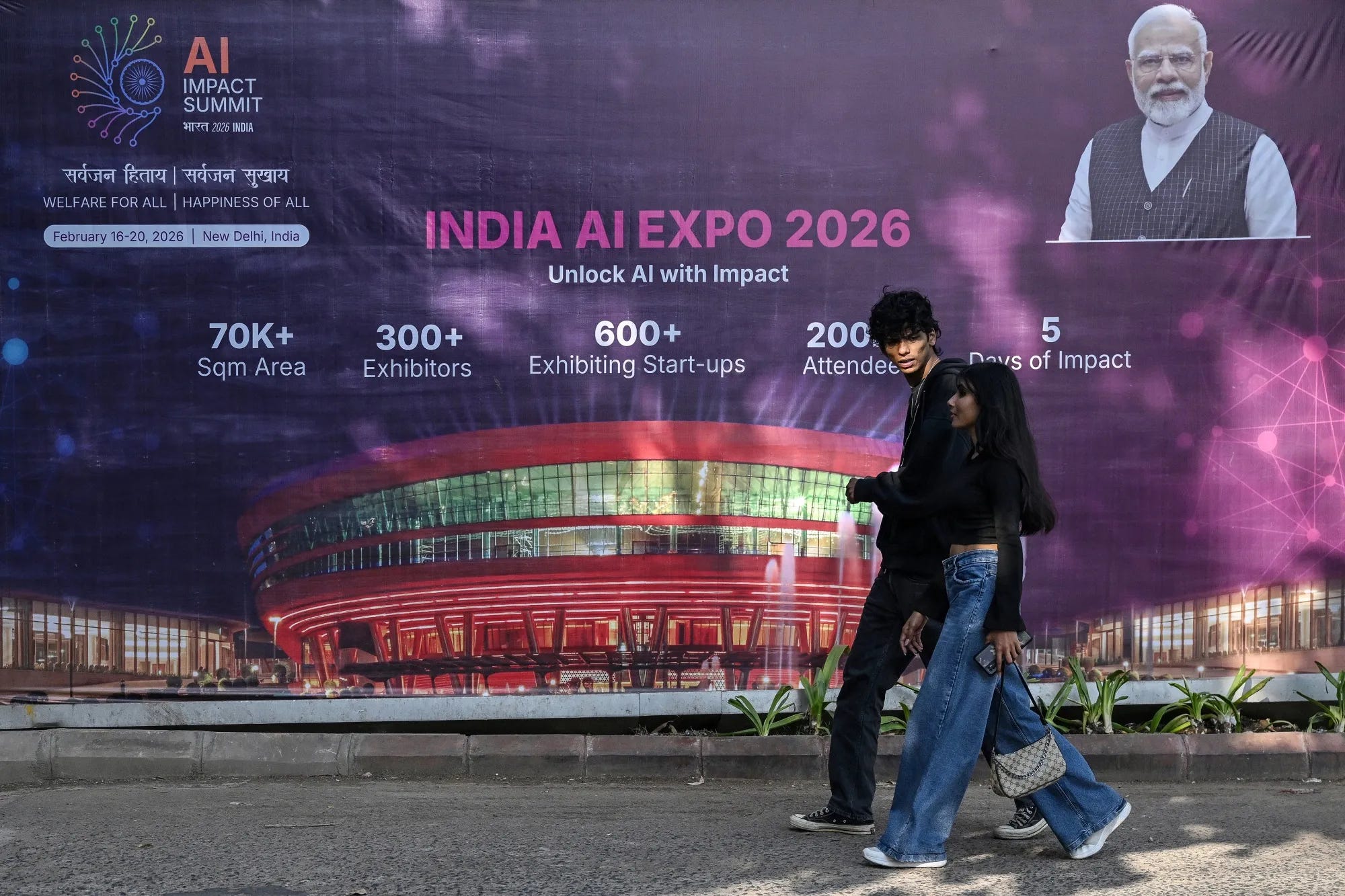
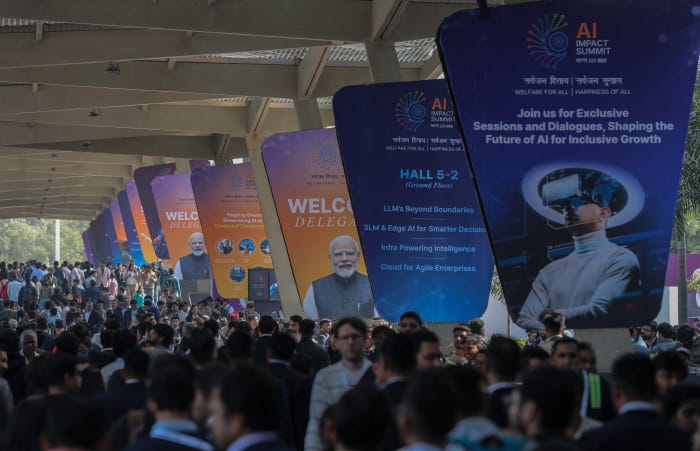
So for all those reasons, this week’s first government driven ‘India AI Impact Summit 2026’, in New Delhi, with the heads of most of the US big tech companies attending.
“India expects to attract more than $200 billion in artificial intelligence-driven investments over the course of two years.”
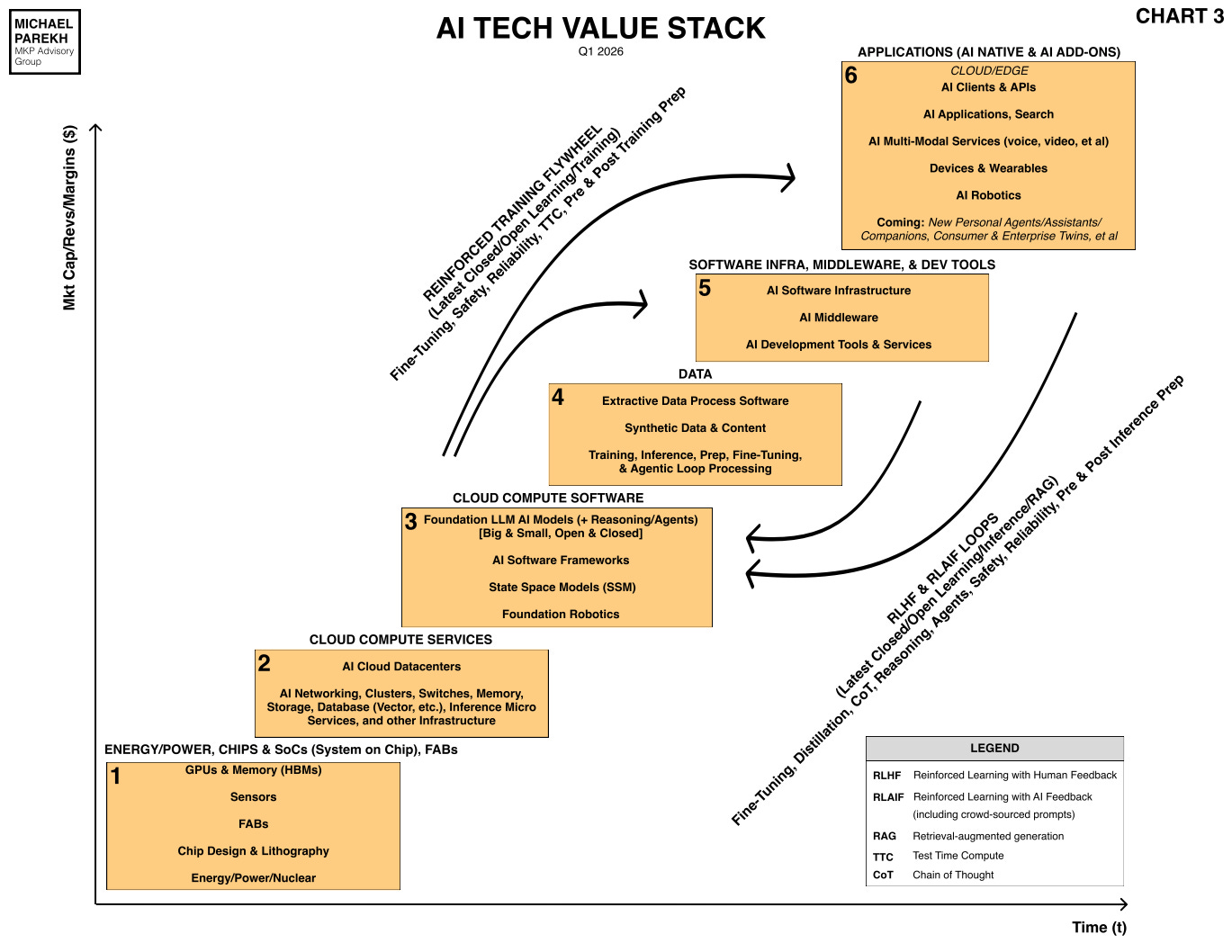
“A five-layer framework has been designed to democratize and deploy AI technology at scale, comprising applications, AI models, compute capacity, data centers and network infrastructure as well as energy.”
“Investment is coming in all the five layers of AI stack, with VCs committing funds for deep-tech startups, big solutions and applications, and further research in cutting-edge models.”
“India expects to attract more than $200 billion in artificial intelligence-driven investments over the course of two years, a top federal minister said, underscoring the world’s most populous nation’s surging ambitions in the new technology.”
It’s a well articulated plan up and down the AI Tech Stack. One addressing India’s strengths, needs and aspirations. The one below is the global template, with the US in the lead.
It goes down from Box 6 above, all the way to the foundations in Box 1:
“Prime Minister Narendra Modi’s administration has designed a five-layer framework comprising applications, AI models, compute capacity, data centers and network infrastructure as well as energy to democratize and deploy the technology at scale.”
“Investment is coming in all the five layers of AI stack,” Technology Minister Ashwini Vaishnaw told reporters at the India AI Impact Summit in New Delhi. “We have seen VCs committing funds for deep-tech startups, we have seen VCs and other players committing funds for big solutions and big applications, we have seen VCs committing funds for further research in cutting-edge models.”
It’s a week long agenda on all things AI, with a chockfull of the AI luminaries from the US and around the world in attendance.
“New Delhi kicked off the India AI Summit Monday, and Modi is scheduled to address the event on Thursday. In attendance will be more than a dozen heads of state, including from France and Brazil, and some of the most influential leaders in the tech world — from OpenAI’s Sam Altman, Alphabet Inc.’s Sundar Pichai to Anthropic PBC’s Dario Amodei.”
The WSJ rightfully characterised it as a “Frugal AI Strategy”, offering an Indian Blueprint for other developing countries:
“The world’s most populous country is looking at how it can become an artificial-intelligence power without breaking the bank.”
“India is promoting its strategy of developing affordable, localized AI tools and infrastructure as a model for other middle-income nations.”
“Adalat AI, a tool trained on Indian case law, is recording witness depositions and producing hearing records in thousands of courts.”
“Global companies like Google, Microsoft, and Amazon have pledged billions for India’s data center and AI infrastructure.”
“India expects to attract more than $200 billion in AI-driven investment over the next two years, Technology Minister Ashwini Vaishnaw said Tuesday at the India AI Impact Summit in New Delhi. The scale is new for India. The projection reflects a pile-up of commitments from foreign and domestic players: Adani Enterprises’ $100 billion pledge for renewable-powered AI data centers by 2035, Blackstone’s $1.2 billion deal backing Indian GPU cloud startup Neysa, coordinated capital pushes from at least six major global venture firms. Sam Altman, Sundar Pichai, Dario Amodei all flew to New Delhi for the four-day summit. Indian IT stocks, meanwhile, hit their worst stretch since April. The technology being celebrated could hollow out the outsourcing industry that pays their workers.”
All waiting for the right set of federal, state, and private initiatives to accelerate the ball forward to meaningfully move the needle. The headwinds have been long understood:
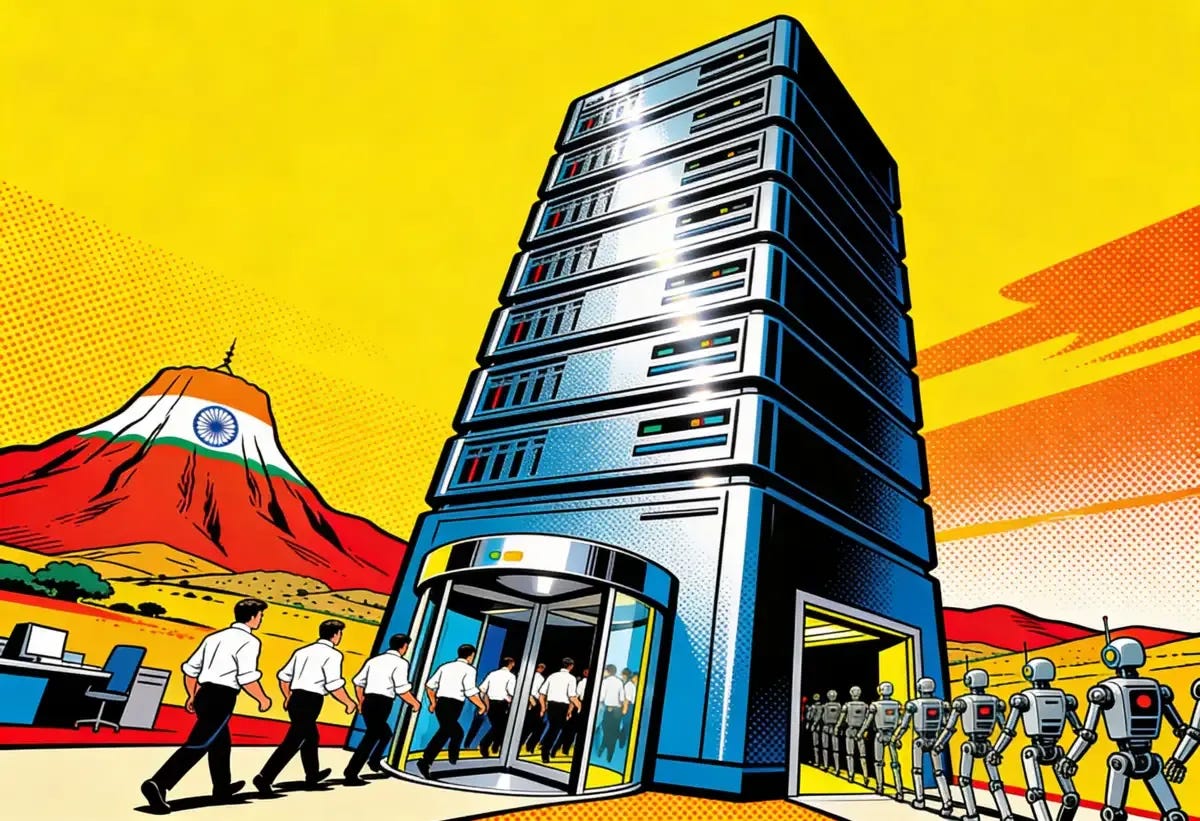
“The tension running through the week is hard to miss. Billions are pouring into AI infrastructure, compute capacity, and Indian startups. At the same moment, the technology receiving all that money threatens the IT services sector that built India’s modern middle class. For three decades, India constructed the world’s back office. Now it is funding the technology designed to empty it. Vinod Khosla, speaking at the summit, told Hindustan Times that IT services and business process outsourcing could “almost completely disappear” within five years. He was not the only one saying it. HCL CEO Vineet Nayyar told attendees that Indian IT companies “will focus on turning profits and not being job creators.”
The big initiating set of investments are of course in AI Data Centers and Power. These can comes from the biggest private Indian conglomerates, Adani and industrialist Mukesh Ambani’s Reliance Industries:
“Adani’s pledge covers construction of renewable-powered AI data centers, scaling the conglomerate’s existing two-gigawatt capacity to five gigawatts. The company projected the investment would trigger an additional $150 billion across server manufacturing and sovereign cloud platforms, creating what it described as a $250 billion AI infrastructure build-out over the next decade. “For decades, we imported technology,” Chairman Gautam Adani posted on X. “Now we are building the backbone.”
“Adani’s $100 billion number comes with a 2035 deadline, though. Nine years of construction. The more immediate money is arriving through private equity and venture capital.”
“Blackstone led a $600 million equity investment in Neysa, a three-year-old AI cloud company founded in 2023 that plans to raise another $600 million in debt and deploy over 20,000 GPUs domestically. Teachers’ Venture Growth, TVS Capital, 360 ONE Assets, and Nexus Venture Partners also participated. It is the largest AI funding round in Indian history.”
“Venture capital commitments, while smaller per firm, may matter more for the startup pipeline. Khosla Ventures, General Catalyst, Lightspeed, Peak XV Partners, Accel India, Andreessen Horowitz, and Prosus are all expected to commit $300 million to $500 million each. “Even if five to six VC firms commit to this amount, the dry powder targeted for AI startups would run up to over $1 billion,” a Bengaluru-based investor told the Economic Times. “That is more than what startups raised last year.”
Home grown AI startups are starting from a smaller base relative to China and beyond:
“India’s AI startups raised around $643 million across 100 deals in 2025, per Tracxn data. US AI startups raised $121 billion in the same period. That ratio has hung over every India AI conversation for the past year, and the summit is an attempt to compress it.”
The US big tech companies are all there, including Nvidia:
“Hyperscaler investment is already in execution. Google pledged $15 billion for data centers in southeastern India last October. Microsoft committed $17.5 billion in December, its largest investment in Asia. Amazon pledged $35 billion across its India operations over five years the same day. Vaishnaw put data center plans already underway at roughly $70 billion, counting projects across at least four states.”
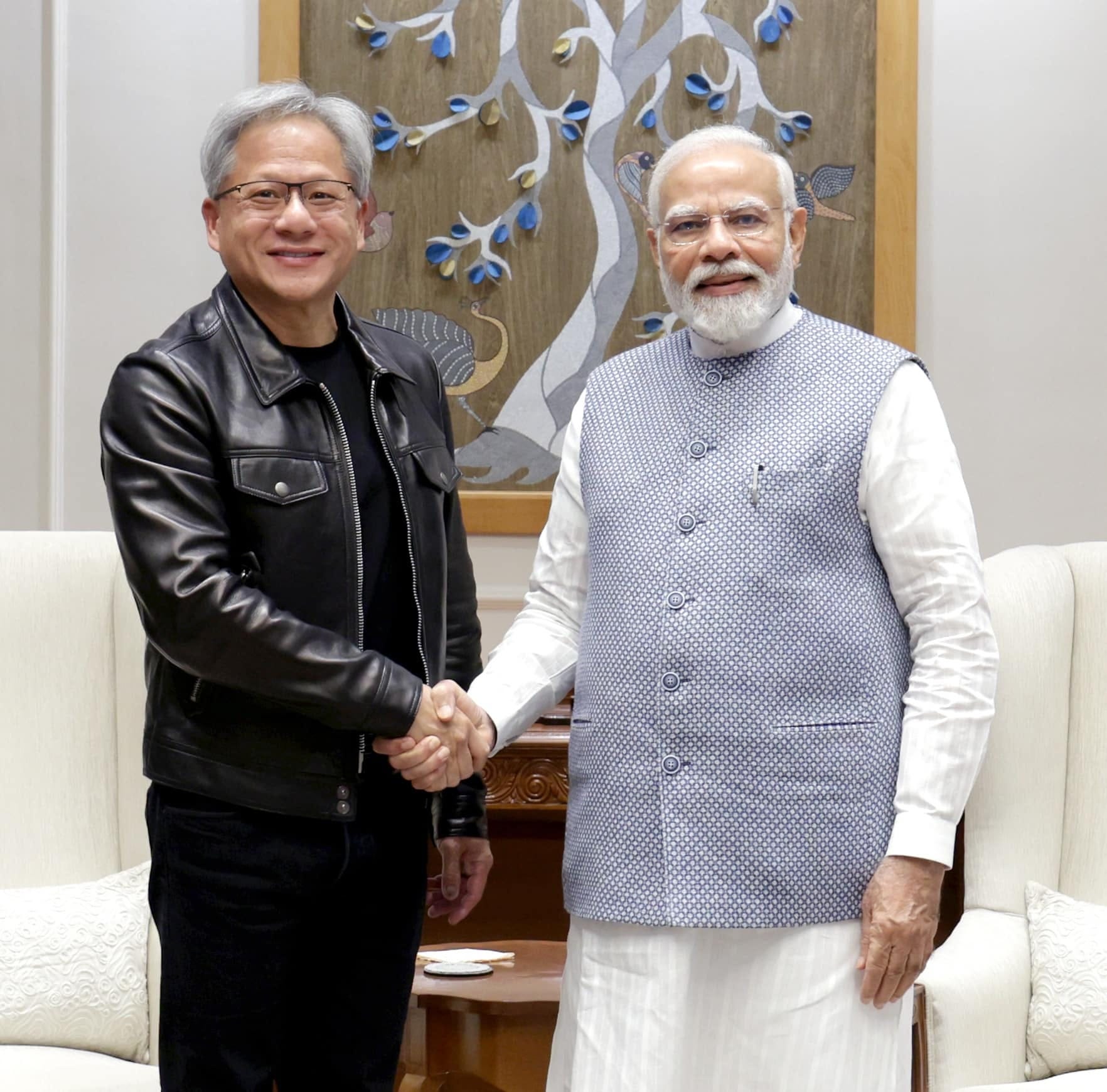
“Jensen Huang pulled out at the last moment. No explanation. Vaishnaw called the absence “unavoidable,” adding that Nvidia was still working with Indian firms on large AI infrastructure investments.”
The major US LLM AI companies Anthropic and OpenAI both had their own announcements while its founder/CEOs Dario Amodei and Sam Altman were in India:
“Anthropic opened its first India office in Bengaluru this week, its second in Asia after Tokyo. India is the second-largest market for Claude.ai, and nearly half of Claude usage in the country involves coding and mathematical work, not casual chatbot conversation. OpenAI’s Altman put his own numbers on the table: India now accounts for more than 100 million weekly active ChatGPT users, second only to the United States.”
“The bigger commercial move is Anthropic’s partnership with Infosys. The two companies will combine Claude models, including Claude Code, with Infosys’s Topaz AI platform to build custom agents for regulated industries. Work starts in telecommunications and expands into financial services, manufacturing, and software development.”
The Indian government is also ginning up the various government agencies to participate:
“Indian government agencies are moving too. The Ministry of Statistics launched the country’s first official government MCP server, letting AI systems query national statistics directly. Food delivery company Swiggy built its own MCP integration so customers can order groceries through Claude. Anthropic now has paying customers, government partners, and a physical office in the city where much of India’s outsourcing workforce goes to work each morning.”
All of these moves are the table stakes. Just being thrown in as the ante.
Next up is the consistent, bottoms up and down down marathon execution needed over the rest of the decade to make this AI Tech Wave truly matter for India. Stay tuned.
Podcasts Barry Ritholtz talks with Jan van Eck about thematic investing. (ritholtz.com) Bogumil Baranowski talks money and purpose with Morgan Ranstrom...
The Bigger Picture, Sunday, March 1, 2026 This week’s AI news gave me reason to bring up one of the most unexpected charts (from last year), from an...