“GitHub’s AI coding lead is evaporating due to rivals like Cursor and Claude Code.”
“Frequent outages and strained margins threaten GitHub’s core repository business.”
“Microsoft plans to develop its own AI models and hike Copilot prices.”
“No part ofMicrosoft better illustrates its predicament in AI than GitHub.”
“The AI boom has boosted usage and revenue of the code repository as well as GitHub Copilot, an AI coding assistant. But GitHub has struggled to respond to new AI coding competitors that have since overtaken it. And the service has suffered from frequent and major outages, peeving big customers and prompting Microsoft to issue an apology.”
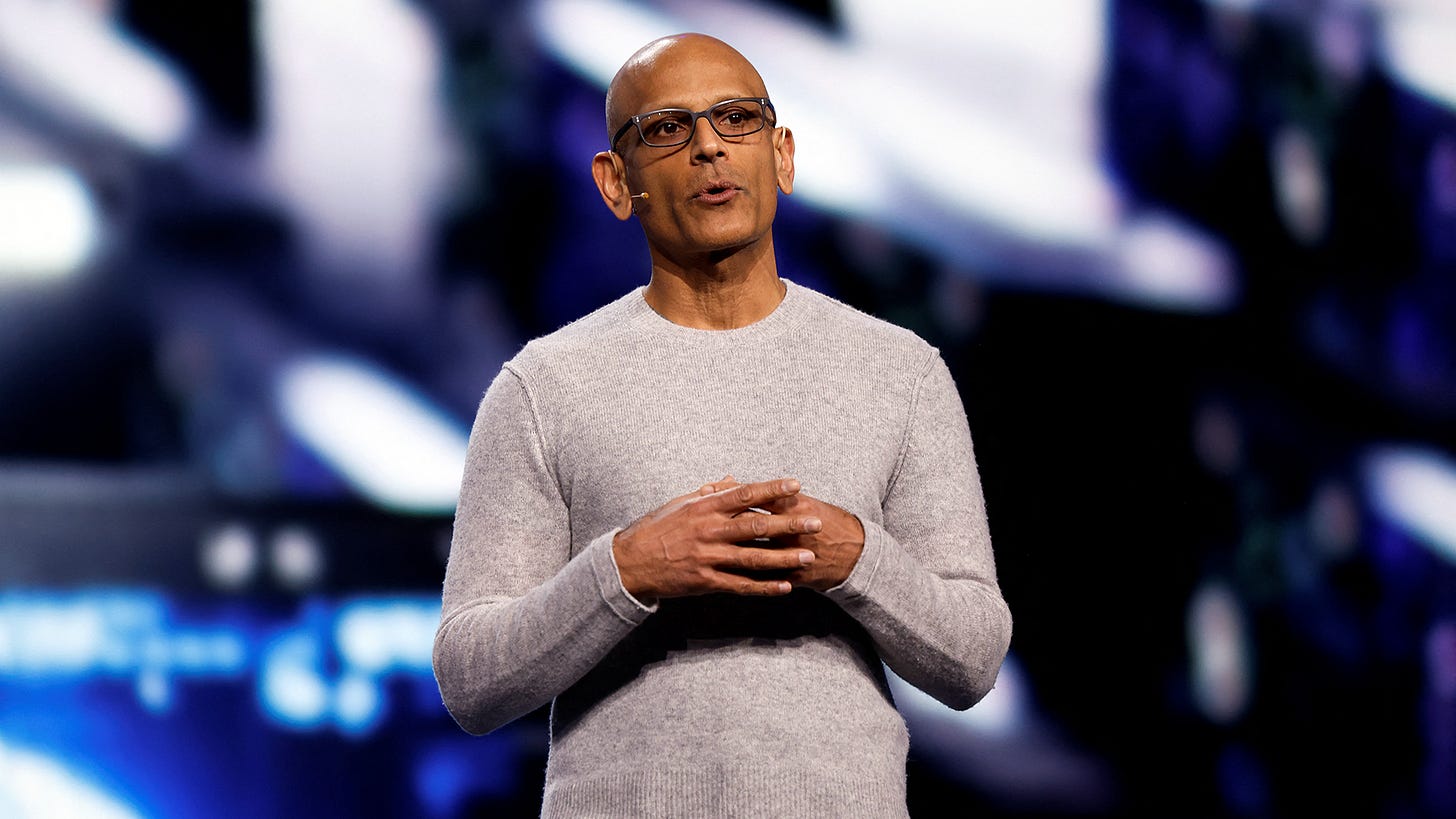
“In recent months, Jay Parikh [No Relation], who oversees the division that includes GitHub, has privately warned colleagues that the unit faces a critical threat.”
“Parikh told deputies that if GitHub doesn’t adapt, rivals like Cursor and Claude Code could displace not just Copilot but the core repository itself. His fear: Developers using integrated tools like Cursor will stop uploading their code to GitHub altogether, rendering the repository service obsolete, according to two people who heard the remarks.”
“Microsoft’s adaptation plan includes developing its own strong AI coding models to lessen GitHub Copilot’s dependence on those from OpenAI and Anthropic. To train new models, Microsoft is using data from employees’ internal use of AI tools as well as from GitHub customers, such as the code they upload to the platform, according to someone who has worked on the effort.”
“Microsoft also has eyed potential acquisitions of AI coding startups, including Sourcegraph, to bolster GitHub’s offerings and talent, according to people with knowledge of the talks. Microsoft executives last year considered acquiring a bigger coding rival, Cursor, but demurred over EU antitrust concerns, according to a person involved in the talks. SpaceX has since signed an agreement to buy the startup for $60 billion.”
It’s been a big change in a short time:
“Two years ago, GitHub Copilot had a phenomenal lead over the rest of the world. Today, it still has mindshare, but they’re no longer the clear leader,” said S. Somasegar, a managing partner at Madrona Venture Group who previously led Microsoft’s developer division and advised CEO Satya Nadella to acquire GitHub. Microsoft did so in 2018 for $7.5 billion.”
“They need to keep innovating on both products and on their business model,” Somasegar said.”
And it goes beyond AI Coding.
“The same criticism could be made about most of Microsoft’s other core applications, which are facing similar threats from Anthropic’s and OpenAI’s AI agents and chatbots for white-collar workers. Both Anthropic and OpenAI recently released new features that automate work within Office 365 apps, competing directly with Microsoft’s Copilot AI tools.?”
“Microsoft’s ability to weather new competition this year will determine how vulnerable it is to activist investors. The company’s stock is down more than 10% so far this year, more than any other Magnificent Seven stock, and some large shareholders have dumped their positions, citing fears that new AI tools will supplant its productivity software business. Microsoft assuaged some of those concerns during its latest earnings call last week when it showed that it had over 20 million paying users of 365 Copilot, up 33% from the quarter prior and implying over $7 billion in annual revenue.”
“It also said it was generating more than $3 billion a month, or $37 billion in annualized sales, from AI-related products and services. Most of that figure is tied to renting out cloud servers to OpenAI, which has a much lower profit margin for Microsoft than its apps business.”
But core market is one that Microsoft co-founder and earlier CEO Steve Ballmer made famous decades ago:
“Developers, Developers, Developers”
“GitHub, which hasn’t had a dedicated leader since last summer, has been a key plank of Microsoft’s cloud business, deepening its relationship with a newer crop of application developers. Microsoft’s obsessive focus on keeping such developers in its camp had for decades helped entrench Windows’ market position, epitomized by former CEO Steve Ballmer’s infamous onstage chant (“Developers!”). GitHub was supposed to revive such ties.”
The history to date is notable:
“Thanks to Microsoft’s partnership with OpenAI, which started in 2019, GitHub pioneered GitHub Copilot using OpenAI’s technology in 2021, more than a year before the advent of ChatGPT. Microsoft then capitalized on its early lead with GitHub Copilot to win some business away from cloud competitors like Amazon and Google by bundling GitHub Copilot and other GitHub services with its broader cloud suite.”
“Then in 2024 along came Cursor, which presented an AI coding tool that could handle more complex tasks, while GitHub Copilot was still primarily offering autocomplete suggestions for coders as they typed. Anthropic in mid-2025 followed with Claude Code, powered by its state-of-the-art AI to automate even more difficult coding tasks, and OpenAI has been rapidly improving its competing tool, Codex.”
But Github Copilot kept pace for a while:
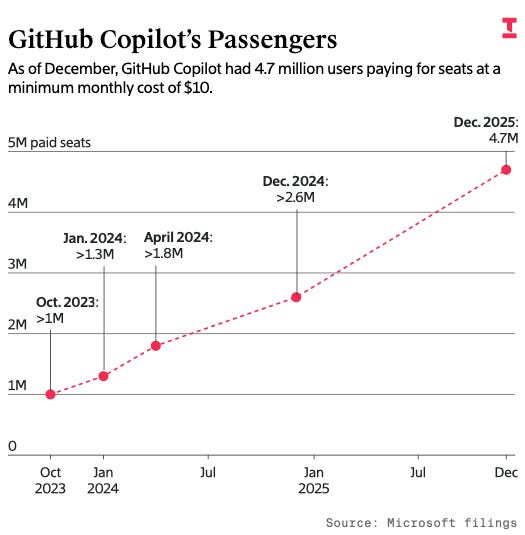
“Despite competition from faster-growing rivals, GitHub Copilot grew steadily as the global market for AI coding tools expanded, and it has also developed agentlike features. Paid users of GitHub Copilot have risen from just over 1 million in early 2024 to more than 4.7 million in December 2025, according to company disclosures. (OpenAI’s Codex tool doubled its weekly users to 4 million between March and April, but that product includes a free tier.)”
“The GitHub figures imply the tool was on track to generate at least $550 million annually at the time, based on the cheapest subscription tier price. At the end of 2025, GitHub’s annual recurring revenue was more than $3 billion, according to someone with knowledge of the business. That figure suggests the unit generated only around 1% of Microsoft’s revenue last year.”
But it’s relative profitless prosperity for now:
“Meanwhile, traffic to GitHub has exploded, growing 14 times over the past year as customers use their own AI tools to upload and edit code in the repository. Not all of that traffic turns into revenue: GitHub doesn’t charge customers for basic services like uploading and modifying code. And it generally doesn’t charge people for using even more advanced AI features, such as detecting and suggesting patches for software vulnerabilities, in public repositories that open-source projects rely on.”
“Firms like Citi and Intel have privately complained about the outages in recent months, according to two Microsoft employees with knowledge of the conversations.”
And there have been capacity issues to boot:
“The added traffic has strained GitHub’s gross margins and led to a surge in outages. It has also forced the company to raise prices for some AI features, which has annoyed customers, some of whom say they’re now exploring leaving GitHub for competitors such as GitLab.”
“Like many of its rivals, GitHub Copilot has struggled with margins because Microsoft has been subsidizing the biggest subscription customers of the AI tool. GitHub’s cost for running the AI models many power users consumed through GitHub Copilot exceeded the monthly price of their subscriptions, leaving Microsoft to eat the costs, according to one of the current employees. Microsoft Chief Financial Officer Amy Hood admitted as much in an April earnings call, noting that “increased GitHub Copilot usage” drove down gross margins in Microsoft’s cloud unit during the quarter.”
“Microsoft is now planning to hike the price of GitHub Copilot by charging based on usage, it said last month, and has temporarily stopped people from signing up for cheaper subscriptions. The price increase could turn off some customers, such as IT services firm NinjaOne, which said it is steering more of its engineers to use Anthropic’s Claude Code as GitHub changes to usage-based pricing.”
“Parikh and his deputies also have discussed new ways to charge customers more—without alienating them—based on how much their external AI agents use the code repository service, according to a current employee with knowledge of the company’s thinking.”
The other longer road it to develop its own core products in this area to change the financial curves:
“To develop Microsoft’s own AI coding models and lessen reliance on OpenAI’s and Anthropic’s, Parikh has directed GitHub teams to gather more coding data only Microsoft has access to, such as code its roughly 100,000 software engineers write and edit, according to someone with knowledge of the effort. Other major AI developers use similar data from employees to improve their models.”
“Last week, Rajesh Jha, who oversees tens of thousands of employees working on Windows and Office software, told staff they would have to use GitHub Copilot CLI, a version of the tool that makes it function more like Claude Code. Staffers on those teams had become prolific users of Claude Code, but Jha said he would cancel those licenses by the end of June, according to someone who received the memo, which The Verge earlier reported.”
“Microsoft is also starting to use data gathered from GitHub Copilot’s external customers to develop and improve new coding models.”
The whole piece is worth a closer read for additional details on Microsoft’s issues and efforts in this importat area. But for now it’s clear the company is focused on tackling the issues in a white hot race. Refitting the plane while its flying as fast as it can.
Something familiar to its peers ahead and behind in this AI Tech Wave. A race that remains full of surprises. Stay tuned.
(NOTE: The discussions here are for information purposes only, and not meant as investment advice at any time. Thanks for joining us here)
Autos What happened to the affordable, basic American car? (nytimes.com) SpaceX is a big buyer of Tesla ($TSLA) Cybertrucks. (finance.yahoo.com) Hyundai...