
’Us vs Them’ Comes to Trillion $+ Enterprise AI & more. ARD #111

Today’s theme: defining ‘The Other’ in the fast-developing ‘Us vs Them’ Enterprise AI market narrative. Enterprise software companies large and small are aligning themselves against the frontier AI companies — Anthropic and OpenAI in particular. Especially Microsoft and Palantir in recent days. Painting themselves as on the side of enterprise customers — especially on protecting proprietary data and business IP from ‘bad,’ ‘hoovering’ frontier labs.
It’s a smart and time-worn strategy: go where the Big Money resides — the Enterprises, with trillions to deploy in AI software and infrastructure through the rest of this decade and beyond, as businesses re-architect 50 and 60 years of accumulated software around AI. Three events for the AI Tech Wave — each with my Take first, then my Overall Take. And this being the eve of the 250th July 4th, a personal reflection at the end that ties it all together — from a golden record flying through interstellar space.
(1) Palantir’s Alex Karp Sharply Echoes Satya Nadella’s Call to ‘Pick a Side’
MP TAKE: Every campaign — in politics, in geopolitics, for thousands of years — needs a crisp definition of ‘the Other.’ A cogent ‘Us vs Them’ narrative. It’s the oldest coalition-building playbook humanity has: before it organized software markets, it organized city-states, religions and Cold War blocs. This week, Microsoft and Palantir both picked their side against Anthropic and OpenAI — but notice: they’re running two different campaigns against the same ‘Other.’
Nadella is the incumbent-insider. The one with a leg in all the camps. Microsoft remains OpenAI’s biggest investor-partner — a stake worth at least a couple of hundred billion dollars as and when OpenAI goes public at a trillion or more, plus access to OpenAI’s IP for the next five years based on certain thresholds. So his essay’s “we can’t let AI giants eat the economy” is a partner hedging from inside the tent: repositioning Microsoft as the enterprise’s trusted broker while owning a multi-hundred-billion-dollar piece of the very ‘Them’ he’s warning about. In campaign terms, that’s the policy platform.
Karp is the outsider-warrior — his is the rally. His entertaining 20-minute Squawk Box interview (worth watching for entertainment purposes alone — links below, segment starts at 18:30) built sharply on Nadella’s essay. “Something has gone completely wrong,” he said of the token pricing model. Enterprises are “going to chillax and waste my time with tokens.” A 9-point ‘AI sovereignty’ manifesto dropped on X the day before. And listen to his exact words: enterprises want to “own the means of production.“ That’s Karl Marx vocabulary — ideology-grade rhetoric, not product marketing — casting enterprise customers as the proletariat against the frontier-lab landlords. Statesman and street-fighter. Same ‘Other.’ And it worked: Palantir jumped 8% on the interview. The performance is the product. Former White House AI Czar and VC David Sacks supplied the campaign’s chorus: a frontier lab can’t “hoover up [enterprise] proprietary knowledge and turn it into their next product.”
Why now? Because Anthropic and OpenAI are racing to ‘hoover up’ over $100 billion-plus in enterprise revenues — Anthropic has gone from nowhere to a $50 billion-plus ARR this month on the runaway success of Claude Code and Cowork, with OpenAI not far behind — en route to their trillion-plus-dollar mega-AI IPOs. The traditional enterprise software players — Microsoft, Palantir, Salesforce — are startled, and slowing the frontier labs down is a perfectly normal competitive response. To zoom back on the picture: as in every such campaign, businesses will end up doing some of each until the narrative veers the majority one way — or doesn’t. Too early for that call. The war and its battles are just beginning. And savor the irony — the game within the game: Palantir — Palantir! — positioning itself as the guardian against data-hoovering. Yes, the same Palantir working with every part of the Government, Military and otherwise, employing beyond-NSA-grade technologies to ‘hoover up’ horizontal and vertical information across every domain, foreign and domestic.
Sources, in narrative order: CNBC — Palantir’s Karp bashes token-based AI model as ‘completely wrong’ · full Karp interview (YouTube — segment starts at 18:30, runs ~20 min). WSJ — Microsoft’s Satya Nadella: ‘We can’t let AI Giants eat the economy’. David Sacks (X) — the frontier-lab ‘hoover’ quote. For longtime readers: ‘Microsoft picks a side vs Frontier AI Models’ in AI-RTZ #1127.
(2) The Nvidia and Palantir Enterprise AI Deal
MP TAKE: The reason Karp was on TV in the first place: Nvidia and Palantir announced an enterprise AI deal — and it’s a shrewd move by Nvidia and founder/CEO Jensen Huang. Notice the pattern: Jensen partners closely with everyone. Palantir here; Microsoft’s Satya Nadella; Amazon’s Andy Jassy; Google’s Sundar Pichai; Oracle’s Ellison; and many others — Meta’s Mark Zuckerberg and Elon of course among them, especially as those two ramp up their Amazon-AWS-style ZWS (Zuck Web Services) and EWS (Elon Web Services), as I call them. He physically delivers the latest and greatest chips to the CEOs, shows up at their keynotes — and each time he shows up, he collects a few billion dollars in orders from the same companies. In an ‘Us vs Them’ war, Nvidia is the arms supplier to every side — and picking every side.
The particularly smart part: Nvidia is leading with its open-source Nemotron hardware/software AI strategy — I’ve written about Nvidia’s timely open-source strategy in detail — running on the infrastructure of those same hyperscaler and application-software partners. Here it’s a major new distribution mechanism for Nemotron: secure AI for US government agencies through Palantir’s customer base, with Karp confirming some government customers have already switched to open-source AI models. That lands squarely on the thesis I laid out in AI-RTZ #1089: Nvidia (and Apple) are the natural US open-source AI champions — and this is Nvidia stepping into exactly that role while the frontier labs sit in their post-Blip-2.0 stop-and-go. To widen the lens: Jensen pointedly does NOT play ‘Us vs Them.’ He’s been the extraordinary diplomat — among all the American combatants, and at the higher US-China level too, with President Xi coming to the United States in September (remember President Trump picking Jensen up in Alaska aboard Air Force One en route to China last time). Working with all of the above — Machiavelli would be proud. And Barron’s is right to ask whether the deal can also rescue Palantir’s brutal stock slump. Two birds, one open-source stone.
Sources, in narrative order: Nvidia — Open Models, Closed Environments: Palantir brings Secure AI to US Agencies with Nvidia Nemotron. Barron’s — Can a new Nvidia partnership save Palantir stock from its brutal slump?. Yahoo! Finance — The Palantir-Nvidia Sovereign AI deal will reshape who wins AI infrastructure. CNBC (Karp) — some US government customers switched to open-source AI. For longtime readers, in narrative order: ‘How Nvidia & Apple can be the global US Open Source AI Champions’ in AI-RTZ #1089; ‘Anthropic’s Blip 2.0 in new form, as China AI ramps’ in AI-RTZ #1131; and ‘Meta & Zuck aiming for the AI Clouds’ in AI-RTZ #1135.
(3) How Enterprises Are Balancing AI Tokenmaxxing vs TokenBudgeting
MP TAKE: Here we take a real read of the Enterprise landscape — what enterprises are actually doing, feeling and thinking about all this AI, and who they like and don’t like. The SemiAnalysis report is one of the most detailed recent surveys of what enterprise customers are really thinking about deploying AI models and applications at scale — and how they’re winding their way between the extremes of Tokenmaxxing and TokenBudgeting. The key takeaway: both are going on at once, and companies are trying everything — frontier models, open-source models, multiple models together. Still very early in deciding these things — even as the market shifts from subscription tiers (the $20-and-$200-a-month plans) toward the à la carte pricing the two frontier labs I covered yesterday want everyone habituated to.
The ‘Cobbler’s Children’ examples are the tell: Tesla capping employee AI spend at $200 a week — call it $10K+ per employee per year — right after its own adoption push. A similar spectrum of evolving internal token budgets at Meta (the leaderboards-to-dashboards swing I covered in AI-RTZ #1118), Uber (which reportedly burned its entire 2026 AI budget early), and others. The FT’s framing says it all: “We created a monster.” To broaden the frame: many of the software tools both AI companies and their enterprise customers need to manage AI spend — monitoring who’s spending what, doing the budgeting — haven’t been fully built yet. These ‘AI Coding’ markets barely existed at this scale a year ago. We are at a very early point in these debates — which is exactly why Karp’s ‘chillax with tokens’ jab in Event One above lands politically. Even if the reality is messier. I plan to track these efforts closely every quarter, and navigate the fundamentals accordingly.
Sources, in narrative order: SemiAnalysis — TokenBudgeting: Our Conversations with Enterprises on Token Spend. The Information — Tesla caps employee AI spend at $200/week after adoption push. FT — “We created a monster”. Yahoo! Finance — Uber burned its entire 2026 AI budget. For longtime readers, in narrative order: ‘Customers asking “how much” for AI tokenmaxxing’ in AI-RTZ #1103; and ‘Meta steps back from AI Tokenmaxxing’ in AI-RTZ #1118.
MP OVERALL TAKE
The guns have gone off in the enterprise campaign for trillions of AI dollars — businesses re-architecting the software they’ve run for the last 50 and 60 years around AI. That’s not going to happen in a few quarters. Like the mainframe-to-minicomputer transition, mini-to-PC, client-server — those took 10 and 20 years each. AI will move faster, but it’s years-fast, not quarters-fast: half a decade, a decade. And in the meantime, the sides are being defined — and will be re-defined.
Recognize these battles for what they are: performative campaigns to define the ‘Us vs Them’ narrative — and to caricature ‘the Other.’ ‘Us vs Them’ is the oldest coalition-building tool we have — it organized city-states, religions, and Cold War blocs long before it organized software markets. Business reaches for it at exactly one moment: early in a tech wave, when the categories are unsettled and the defaults haven’t locked in. When the stakes are still being set, the cheapest way to organize buyers is to hand them an enemy — especially with fear: ‘they’ll take your data and your business IP if you let them.’ Nadella at Microsoft and Karp at Palantir are doing what humans have done in political campaigns and business battles for thousands of years. Same game, same playbook.
And particularly note the timing. These Microsoft/Palantir campaigns launch the very week Anthropic and OpenAI are gated post-’Blip 2.0’ by the White House, totally mid-flip from subscriptions to à la carte pricing (peak customer irritation — yesterday’s show), and pre-IPO, needing clean enterprise narratives. You attack ‘the Other’ when it’s stuck in ‘Stop-and-Go’ traffic — with the US Government as the traffic cop. (And companies like Palantir are very close to that traffic cop.) Our three shows this week are actually one arc: the gating, the pricing ambitions, and now the counter-campaign in the Enterprise.
I’ve seen this movie in every prior enterprise tech-wave battle — first-hand over the decades: IBM’s FUD years against the minicomputer and PC companies; Apple’s ‘1984’ Super Bowl ad literally casting IBM as the Orwellian entity against freedom-loving Apple; Steve Ballmer — Microsoft’s number two for years — calling open-source Linux “a cancer” (Microsoft is now one of the biggest supporters of open source. Irony, irony.); Microsoft versus Netscape in the ‘browser wars.’ Enemy-construction as market segmentation — a standard early-wave feature. The AI Tech Wave just has far more zeros, earlier in the cycle, in both the investing and the revenue earning. It feels dramatic when it’s on CNBC, and it’s very entertaining. But recognize: this is a remake of the same movie.
And the earlier waves all taught the same lesson: there are no binary answers. Customers ended up doing some of each, from both sides — every time. So track data points like this week’s every quarter through the end of the decade. This is a multi-decade campaign for every player and every side. The job is to analyze clearly through the ‘Fog of War’ — and figure out what’s what in this nascent ‘Us vs Them’ Enterprise AI campaign, as we watch it on our TVs and read about it in our blogs and podcasts.
Gadget AI — Microsoft’s Efforts to Bridge Consumer and Enterprise with Copilot AI
MP Take: It’s notable how both enterprise and consumer tech companies are converging on their AI app strategies — fusing the enterprise side with whatever consumer options are at hand. The Information reports Microsoft is merging the consumer and enterprise versions of Copilot into a single app — with coding tools and AI agents — internally dubbed ‘AutoPilot’ (from a memo telling teams to “earn the right to exist”). Microsoft has over 20 million business Copilot users and maybe another 10 million on the consumer side — roughly 30 million, against the hundreds of millions using ChatGPT. That mirrors OpenAI’s desktop ‘super-app’ move — fusing ChatGPT, its browser, and Codex into something you can talk to. And Apple’s Siri AI arrives this fall, leveraging the personal repositories on your iPhone — securely — for AI that’s personalized and indexed on your data. Everyone’s racing toward one AI app to rule them all, across all our gadgets.
To see the bigger picture: only Google and Apple have a genuinely balanced approach across both markets — consumer and enterprise — largely because both have their roots on the consumer side, with Google’s Gemini spanning billion-user apps from Gmail to YouTube. Everyone else is fusing toward the consumer surface from an enterprise base, or vice versa. Where the fusion actually works — versus just re-bundling — is one of the AI-application questions of the next 12 months.
Sources, in narrative order: The Information — Microsoft is merging consumer and enterprise Copilot into a single app, dubbed AutoPilot. CNBC — OpenAI to create desktop super app, combining ChatGPT app, browser, and Codex. For longtime readers, in narrative order: ‘OpenAI trims AI Applications down to “AGI” Basics’ in AI-RTZ #1037; and ‘Apple Intelligence & Siri AI hum with “Google and Nvidia” Inside’ in AI-RTZ #1113.
Questions
Q1 — Which is MP’s daily AI app of choice on the smartphone?
Google Gemini and Perplexity — my two daily apps of choice. And I’m increasingly using Siri AI in developer beta — very raw and early, but I’m liking it so far. It’s uniquely interesting because of its horizontal leveraging of my personal content across a wide range of Apple apps.
Q2 — What is the most-lacking feature in MP’s ‘Go To’ daily consumer AI apps?
As much as all these apps try to leverage data across the system, they still have a lot of wood to chop — especially Google Gemini, which I think has the most potential. It’s surprising that Gemini still doesn’t integrate well with, say, my Google Docs or Google Photos — leveraging the data in all those apps to give me better answers. Particularly given Google’s unique portfolio of billion-plus-user platforms: Gmail, Docs, YouTube, Maps, Photos, Keep and more. Apple is already doing this integration early with Siri AI and Apple Messages, Notes, Photos, Maps, iCloud. That seamless integration is the most obvious feature — and the internally hardest to execute on a sustained basis, across dozens of internal organizations and fiefdoms. Especially at Google. I know they’re working hard on it; it’s just not there. And that’s the new expectations problem for all these companies: regular software used to improve in quarters and years — we now expect it in days. It’ll get fixed soon.
Wrapping up — and a personal note for the 250th July 4th Celebration.
Today’s AI-RTZ #1136 — Nvidia expands Revenue Share Deals with Customers — Nvidia formalizing its ‘AI Compute Partnership’ (ACP): using its balance sheet to provide GPUs and infrastructure to partners in exchange for a piece of their revenues. Straight out of Event Two’s playbook — the arms supplier becoming, as The Information puts it, a kind of central bank to the companies buying its chips. More win-win ‘circular’ deals, with a bigger balance sheet than anyone. Recommended as today’s reading post.
Tomorrow, of course, is the 250th Birthday of these United States — and I want to close with some personal thoughts. Bear with me; it won’t take long. It means a lot to me as a first-generation American. I’ve been waiting for this one for a long time.
It’s important to remember, now more than ever: Americans have historically been more united than they’ve seemed at almost every point in this country’s extraordinary, tumultuous history — through the lows and the highs, with more in common than shows on the surface. I’ve seen it up close and personal since I landed at Auburn University in Alabama in 1977, seventeen years old.
Let me jump off that year — 1977, one of the most remarkable years in the US space program, and most of us have forgotten it. It was the year NASA launched not one but two interplanetary probes, Voyager 1 and 2. I’m a huge freak for both. They were designed to swing past the outer planets — out past the planet that used to be called Pluto — and take pictures. They did that, amazingly. But their designers secretly built them for more, without the budget to do it. These probes carry less computing power than the key fob in your pocket — and today Voyager 1 is over 15 billion miles away, Voyager 2 over 13 billion: the farthest human-made objects in our history, 250 years or otherwise. Their nuclear power runs out in the next few years. Then they go dark — and drift through the cosmos for millions of years.
Each carries a Golden Record, created by one of my favorite authors on space — the famous Carl Sagan — and his wife: a mixtape in a bottle. Our music, our languages, our world, our animals. Everything humans on Earth are about, floating out there since 1977. (I showed my own copy of the Golden Record on today’s show.) And if you want a fun movie this July 4th weekend: Star Trek: The Motion Picture (1979) — no spoilers, but it’s about Voyager. One of my favorites.
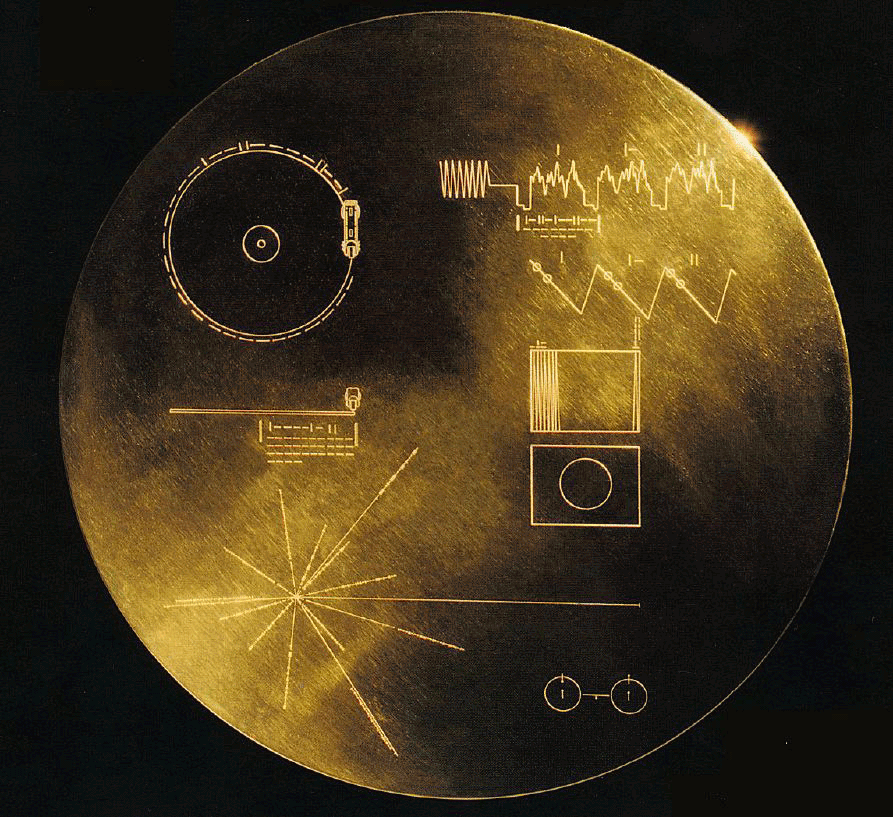
The point: those probes were launched by a united ‘melting pot’ culture punching way above its chronological age — a country barely 200 years old when they went up, 250 now. A people inspired by their science fiction — Star Trek, Star Wars, Isaac Asimov’s I, Robot — to build everything from Google to today’s AI, robots and beyond. (Not that the rest of the world lacks amazing science fiction — China’s Three-Body Problem is case in point.) We are still very early on our own journey of federation: thirteen colonies that became these United States of fifty; federations of nations and peoples, EU and Brexit, ups and downs. A work in progress indeed — with a lot of help from friends, allies and cultures around the world.
And here’s what’s very important to understand about the Space Race — because we keep casting the US/China AI race in its image.
The US/USSR race ignited by Sputnik in 1957 ran until the twelfth and last US astronaut walked on the Moon in 1972 — and then we all forgot about the Moon. (We only want to go back now, with Artemis, because China wants to go too. Politically, that’s how the money flywheels move.)
But since 1975 there’s a history most of us have forgotten: the Apollo-Soyuz handshake in space — two Cold War adversaries docking in orbit just three years after the last moonwalk.
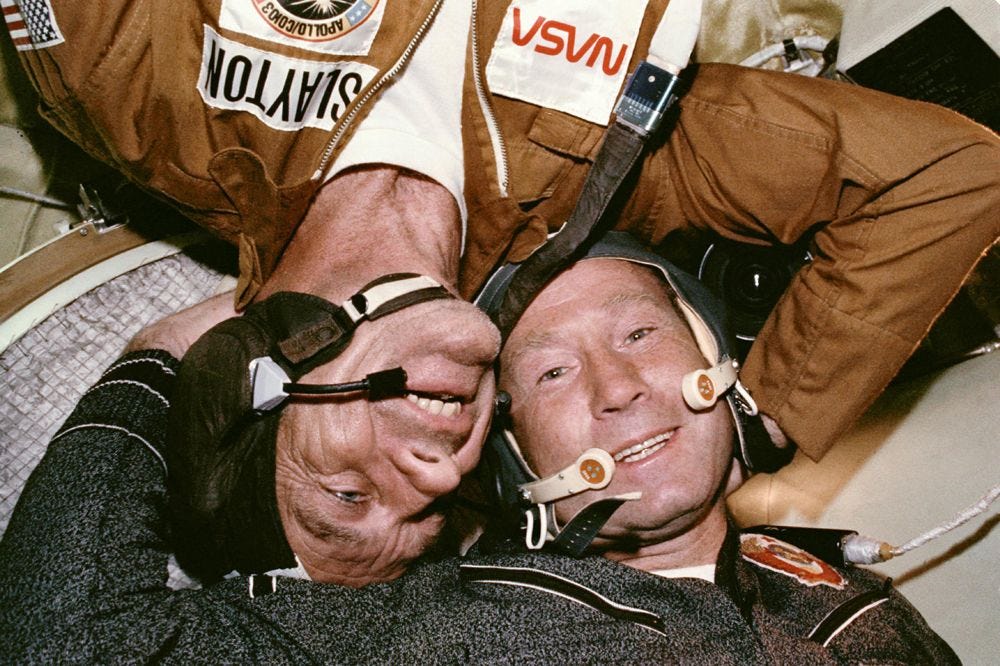
It led to the Shuttle-Mir missions, and to the International Space Station that both countries have run together for over 25 years and $200 billion-plus in joint global investments.
The Americans and Russians have done more in space together than they’ve done separately. The competition — the ‘Us vs Them’ narrative I talked about all show — is what makes the headlines and moves the money. But things get built more together than they do apart.
That’s what I’m celebrating this weekend. What America has done with and around the world with technology in particular. It’s been the spine of my life in the US these past fifty years.
Happy 250th Birthday, these United States — and here’s to the next 250+ years together, working with countries and peoples around the world.
Tomorrow — the Saturday Weekly Roundup. And Sunday, The Bigger Picture.
Have a great July 4th Weekend!
Thanks for joining us today, AI Curious Folk. Stay tuned.
Full Source Reading —
For the broader context, see the canonical sources for ARD 111 — in today’s narrative order:
Event 1 — Karp Echoes Nadella’s ‘Pick a Side’
-
CNBC — Palantir’s Karp bashes token-based AI model as ‘completely wrong’
-
CNBC/YouTube — full Karp interview (segment starts 18:30, ~20 min)
-
WSJ — Microsoft’s Satya Nadella: ‘We can’t let AI Giants eat the economy’
-
David Sacks (X) — the frontier-lab ‘hoover’ quote
-
AI-RTZ #1127 — Microsoft picks a side vs Frontier AI Models
Event 2 — The Nvidia-Palantir Enterprise AI Deal
-
Nvidia — Open Models, Closed Environments: Palantir brings Secure AI to US Agencies with Nvidia Nemotron
-
Barron’s — Can a new Nvidia partnership save Palantir stock from its brutal slump?
-
Yahoo! Finance — The Palantir-Nvidia Sovereign AI deal will reshape who wins AI infrastructure
-
AI-RTZ #1089 — How Nvidia & Apple can be the global US Open Source AI Champions
-
AI-RTZ #1131 — Anthropic’s Blip 2.0 in new form, as China AI ramps
-
AI-RTZ #1135 — Meta & Zuck aiming for the AI Clouds
Event 3 — Tokenmaxxing vs TokenBudgeting
-
SemiAnalysis — TokenBudgeting: Our Conversations with Enterprises on Token Spend
-
The Information — Tesla caps employee AI spend at $200/week after adoption push
-
Yahoo! Finance — Uber burned its entire 2026 AI budget
-
AI-RTZ #1103 — Customers asking ‘how much’ for AI tokenmaxxing
-
AI-RTZ #1118 — Meta steps back from AI Tokenmaxxing
Gadget AI — Microsoft Copilot/AutoPilot
-
The Information — Microsoft merging consumer + enterprise Copilot into ‘AutoPilot’
-
AI-RTZ #1037 — OpenAI trims AI Applications down to ‘AGI’ Basics
-
AI-RTZ #1113 — Apple Intelligence & Siri AI hum with ‘Google and Nvidia’ Inside
The 250th personal note — Voyager, Sagan & the handshake
-
Wikipedia — Voyager Golden Record · Carl Sagan
-
NASA — Apollo-Soyuz Test Project · Wikipedia — Apollo–Soyuz
-
Wikipedia — Shuttle–Mir program · International Space Station
Clips from today
Clip 1 — Voyager’s Golden Records: A Message in Space
In 1977 the US launched Voyager 1 and 2 — each carrying a golden record curated by Carl Sagan and his wife: humanity’s mixtape in a bottle, with our music, languages and world aboard.
MP Take: A united ‘melting pot’ culture punching way above its chronological age sent the farthest human-made objects in history into the cosmos — with less computing power than your car key fob. They go dark in a few years, then float for millions more. Who we are, out there forever. Happy 250th, USA.
Clip 2 — AI’s Long Road: Years, Not Quarters
The enterprise campaign for trillions of AI dollars means re-architecting 50-60 years of business software. The guns have gone off — but this race runs long.
MP Take: Mainframe to mini, mini to PC, client-server — each transition took 10-20 years. AI will happen faster, but it’s years-fast, not quarters-fast: half a decade, a decade. The ‘Us vs Them’ narratives erupting now are the same playbook from every prior tech wave — just with far more zeros, earlier.
Clip 3 — US-Russia Space Cooperation: A Forgotten History
The Space Race everyone remembers — Sputnik 1957 to the 12th moonwalker in 1972 — ended in a handshake: Apollo-Soyuz, 1975. What followed was five decades of US-Russia partnership in space.
MP Take: Shuttle-Mir, then the International Space Station — run jointly for 25+ years and $200B+ in shared investment, through every geopolitical hiccup. The ‘Us vs Them’ narrative did its job so well we remember the race and forgot the partnership. Worth holding onto as we ponder the US/China AI race today: things get built more together than apart.
Clip 4 — NVIDIA’s Shrewd Enterprise AI Deal with Palantir
Nvidia and Palantir announced an enterprise AI deal — bringing Nvidia’s open-source Nemotron models to US government agencies in secure environments. It’s why Alex Karp was on CNBC in the first place.
MP Take: Notice Jensen Huang’s pattern: he partners with everyone — Palantir, Microsoft, Amazon, Google, Oracle, Meta, Elon — delivering chips personally and collecting billions in orders each visit. In an ‘Us vs Them’ war, Nvidia is the arms supplier to every side, picking every side. And Nemotron distribution makes Nvidia exactly the US open-source AI champion I’ve been writing about. Machiavelli would be proud.
Clip 5 — Voyager Probes: Humanity’s Longest Journey
Voyager 1 is over 15 billion miles out; Voyager 2 over 13 billion — the farthest human-made objects in existence, launched in 1977 with less computing power than a car key fob.
MP Take: Designed to swing past the outer planets and take pictures — but the designers secretly built them for more, without the budget for it. Their nuclear power runs out in the next few years; then they go dark and drift for millions more. Want a fun July 4th movie? Star Trek: The Motion Picture (1979) — no spoilers, but it’s about Voyager. One of my favorites.
About AI Ramblings Daily (ARD), and AI-RTZ
Both are daily. Both are free. Both are about AI. But they’re different mediums carrying different messages.
AI-RTZ is the morning text — a deeper written take on one idea, published by at least 5 AM EST. Today: post #1136.
AI Ramblings Daily is the afternoon video + podcast — my ad hoc takes and perspective on the day’s AI issues & news flow, around 20 minutes, with short 1-2 minute clips for quick topic views. Today: episode #111.
Subscribe to either or both on michaelparekh.substack.com. They run as separate Sections you can opt into or out of.
Links used in today’s show (already embedded inline above; listed here for reference)
Take 1 — Karp Echoes Nadella’s ‘Pick a Side’:
-
CNBC — Palantir’s Karp bashes token-based AI model as ‘completely wrong’
-
WSJ — Microsoft’s Satya Nadella: ‘We can’t let AI Giants eat the economy’
Take 2 — The Nvidia-Palantir Enterprise AI Deal:
-
Nvidia — Palantir brings Secure AI to US Agencies with Nvidia Nemotron
-
Barron’s — Can a new Nvidia partnership save Palantir stock?
-
AI-RTZ #1089 — How Nvidia & Apple can be the global US Open Source AI Champions
-
AI-RTZ #1131 — Anthropic’s Blip 2.0 in new form, as China AI ramps
Take 3 — Tokenmaxxing vs TokenBudgeting:
-
SemiAnalysis — TokenBudgeting: Our Conversations with Enterprises
-
AI-RTZ #1103 — Customers asking ‘how much’ for AI tokenmaxxing
Gadget AI — Microsoft Copilot/AutoPilot:
-
The Information — Microsoft merging Copilot into ‘AutoPilot’
-
AI-RTZ #1037 — OpenAI trims AI Applications down to ‘AGI’ Basics
-
AI-RTZ #1113 — Apple Intelligence & Siri AI hum with ‘Google and Nvidia’ Inside
The 250th personal note — Voyager, Sagan & the handshake:
Companion text:
(NOTE: The discussions here are for information purposes only, and not meant as investment advice at any time. Thanks for joining us here.)
Subscribe to AI: Reset to Zero for daily AI Ramblings + Sunday Bigger Picture posts.


